Wednesday, May 15, 2013

The professional edit: brace yourself and be hooked


(Note: Don't panic when you read the following. It's scary, but you are more than capable of handling it. If you've come this far, chances are, you're a good writer.)

You've decided it's time for a professional edit. Before you begin, there are some questions you need to ask yourself.

How much are you willing to change? Are you willing to receive suggestions for rewriting scenes, such as "I have trouble believing this character is this age; can you make them 35 instead? Here's why." What about suggestions for scene inserts: "I'd like to see a scene of this character arguing with her brother about how he keeps cramping her dating style, instead of her reflecting on it."

There will be suggestions on scene cuts: "Start this chapter here; cut all this." "Too much reflection. Start the chapter 2 weeks ago, show this scene, cut the reflection on the scene, skip time to current day." Your favorite scene: "Head-hopping: you've never used this character's point of view before. And they're not important to the story. Cut this scene or rewrite from someone else's point of view."

What about character development issues? "This character seems flat" or "This action doesn't make sense for this character. Either explain why he does this particular OOC thing with a scene from his POV or make someone else do it." "Alpha males don't cry over smacking mosquitoes. Symbolic or not, it seems melodramatic and doesn't make sense for him."

Even the best writers get back pages and pages of things to improve during their first few books (and most for the rest of their careers).

I warn you now that your first beta-edit from someone who writes or edits professionally is always, always hard, because these are the edits that are focused on making the story better and more in line with industry standards of writing--which are much stricter than they were 20-30 years ago, meaning the authors we grew up reading get away with stuff we can't. Even if you've got thick skin, it'll make you want to cry. Why? It's just overwhelming to look at a story and see how much someone else thinks should be fixed--although after you start fixing, you realize it's not as overwhelming as you thought.

Good edits push you to move past "good enough" or "at least as good as that other author I've read" into "excellent." That means the stuff you see other authors getting away with, your editor should call you on and tell you to fix it. Whether you do or not is your choice (or not, depending on how and where you publish, and what your contract may be).

Don't panic.

One of the best things you can do as a professional (and if you're publishing and earning money from your books, that's what you are) is to get feedback from someone who doesn't know you particularly well, and who won't try to protect your feelings. That's also the danger of asking friends for beta reads, because close friends aren't willing to point out the things that hurt (and it's always the things that need the most improvement that hurt the worst!) This is why a professional beta read is always a shock, and always painful, even when it's done tactfully. And after giving yourself a couple of days of frustration, tears, and well-earned self-pity, you'll start making the changes--and be hooked.

Seriously. Once you get a real edit, you'll never want to go back to the "this is so great!" again. You won't believe me until you feel it yourself. But as a writer, it's the honest feedback that makes you improve. And once you see what you're capable of, you'll never, ever accept less. Which is why writers treasure professional, tear-inducing edits so much (note: strict can be good, but never "abusive"--don't go with an editor that insults you. Ever. You are a good writer, and you do have what it takes. Someone tells you differently, hit upside the head with a frying pan. I guarantee you, there are pro authors whose first drafts are worse).

I know this all sounds scary. That's why I giving you this warning. Everyone goes through the same thing. I promise. And I also promise that it's worth it.

If grammar or punctuation is an issue, check out OWL at Purdue. Read the whole thing. Seriously. Read it and take notes (study secret #1 for online classes: taking notes by hand improves understanding and memory retention). Your punctuation will improve and you'll know how to avoid the little errors. It's worth taking the time to do.

Grammar Girl is also good for specific questions, especially for commonly confused terms or punctuation issues.

Remember:

You are a good writer. But everyone can be better, and that's the point of editing. Never stop reaching for the next level up.

Published authors: What was your first professional feedback experience like? How do you feel about professional edits today?

Monday, May 13, 2013

Myth-busting: Self-publishing to pick up a publisher

You've got an amazing, awesome, terrific book. It just needs a little editing and a good cover, and it'll be a hit. So someone says you should self-publish it in hopes of picking up a traditional publisher and getting published.

Towel Bunny says,
"It's a trap!"
MYTH

A very common myth, and one many, many debut authors fall for. I do mean it's exceedingly common, which is why I'm posting this. Here's why it's a myth:


1) Self-publish. When you self-publish a book, you are published. 100% published.

2) Traditional publishers do sometimes pick up self-published books, stick covers on them, and officially distribute them. They do this with self-published books that have already hit the best-sellers chart. If you've sold over 20,000 copies, or about 1,000 copies a month, this might be an option. Otherwise, shop another book.


Traditional publishers are out to make money. Therefore, when they look for a self-published book to pick up, what they're looking for is a proven money-maker. See #2. If a book does not have large sales already, it's a proven non-money-maker, or at least evidenced as not being earning potential. They're not interested in purchasing a book that has been published, thus already having been marketed to potential readers and possibly tapping out the market, that has not already made money. It's technically possible that you'll get picked up--technically.

It's sort of like selling cupcakes at a roadside stand, hoping that the local festival would give you one of their 30 designated food stands for that very night--if people aren't lining up by the hundreds to get more because they're just that good, well, you've already sold cupcakes to most of the people who are hungry for them. Why would the festival want to risk selling cupcakes when they could give that spot to the pie-maker, whose pies haven't been out on the market yet? Nobody's had their pie craving filled yet, so the festival (we assume it earns a commission based on your sales) will probably earn more from pies.

That's why publishers are more likely to pick up unpublished authors than self-published authors unless the self-published author can bring in a guaranteed clientele. It's no benefit to the traditional publisher. They have to invest money into cover art and editing, for sales that might already be tapped out, for a book that's possibly already gotten a reputation for being poorly edited.

On the other hand, the news isn't all bad if you're one of the many who have fallen into this myth. Since you plan on being a career author anyway (I assume you are, since the best way to sell books is to write more, and the only way to make a continual salary is to write more--you won't be able to support yourself for a lifetime from the income of single book!), you've got another manuscript in the works/ready to go/formulating in your head. Shop that one to publishers. It can be published under a different name if they're worried about your brand.

Or, decide to go completely self-publishing. Write that second book, edit it, get professional cover art. Learn the ins-and-outs of self-publishing. Become business savvy and go the self-publishing route on purpose. You can make a sustainable living through self-publishing, and with the higher royalty rates, you can do so selling fewer books than you'd have to through a traditional publisher to make a living. Yes, it's a higher initial investment--but it can pay off.

Lots of authors are going the self-publishing route these days. It is a financially sound decision, and there are good reasons for it, just like there are good reasons to traditionally publish. There are also the authors who go hybrid, traditionally published authors who self-publish, and successful self-published authors who make traditional publication deals after reaching that 20,000 sales mark.

Either way, your first step is to clean up your first, self-published book. Get it edited. Get a better cover. Take down the old version and put up the improved version. Track your sales, network, and learn the ins-and-outs of marketing (you'll have to do that any route you take).

No, you shouldn't self-publish a book you want to be traditionally published. But there's no reason to be discouraged if you did--after all, you can write a different series and traditionally publish that, or decide that self-publishing is the right route for you, after all.

Friday, May 10, 2013

10-minute hero

10 Minute Hero:
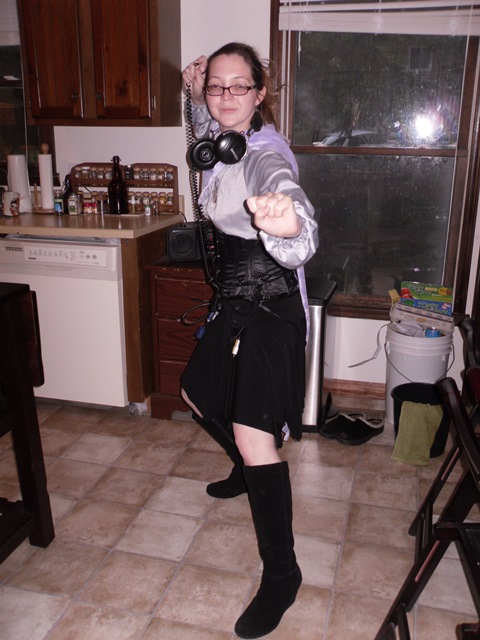
Wired!
Maybe you've heard of the 10-minute hero challenge. It goes something like this: you have 10 minutes, exactly 10 minutes, to transform yourself into a hero with whatever you have on hand. Then you get someone to take a picture.

 "Yeah, right," you say. "Do I look like a hero to you?"

Well, yeah.

See, in my way of thinking, you are a hero. Maybe I don't know you. Maybe you don't think you're very brave or heroic. Maybe you live a life of complete obscurity in a remote island, plotting to take over the world.

But you're someone's hero. Are you a parent or a child's guardian? Then you are sun, moon, and life a child. You are the one person standing between that kid and the universe. What about a pet owner? Same deal. You hung the moon in the sky.

No? Not a parent? Well get this. You're still the one person who stands between an ordinary citizen and disaster. You see, at some point, you'll have a moment of unrelenting awfulness.
Yes, you'll experience something in your life you JUST DON'T
WANT TO DEAL WITH. And you'll do it anyway.


Gee, thanks. Is this supposed to be a pep talk?

 See, we all live through tough times. It's part of being a person. But the fact that you take the time to deal with it makes you someone's hero--because when someone else goes through a bad time, they'll be able to look to you for an example. You survived. So can they.

"Sheesh, wearing my big-girl panties makes me a hero? I think you're confused, lady."

Okay, not convinced? How about this: Have you ever done something nice for someone?

We're each other's first line of defense. Humans are made to look after other humans--it's that instinct, the desire to run towards disaster, that baffles scientists and makes biologists scratch their heads. Altruism exists. And any time you help someone for no reason whatsoever, you're being someone's hero.

Maybe you don't feel like a hero. But just by smiling at a stranger, by letting someone in during rush hour, by tipping the kid who delivers your pizza an extra $5--you've just made someone's day. You've just made the world better for one single person. And that is how the world is made better.

"I'm never nice to strangers."

Well, you're a tough case, aren't you? But you just revealed something in your subtext: You're there for your friends. Let's make this perfectly clear: your friends are humans (or at least they pretend to be). By standing by them, you're a hero to them. Have any of your friends ever called you at midnight after a big breakup? Or been thinking about quitting something loved, and you talked that friend into keeping going? That's what a hero does.

You don't have to run into a burning building to make the world a better place. You're a hero just as you are: Someone who cares about other people, even when they can't do something for you in return. Someone who makes the world just a little better. That's what being a hero is all about.

So go prove your heroics. You have exactly 10 minutes. Assemble whatever is closest at hand and dress yourself as a superhero. Then get a roommate, cohabitant, or autotimer to take your picture.

What's your 10-minute hero name?


Sidekick kitty wonders if Superhero Wired has any
tuna up her sleeves.

Wednesday, May 8, 2013

Creepifying the ordinary

There's nothing creepy about pinning living things to a board!
Nothing at all...
One of the most fun things about being a writer is throwing something unexpected into the fire.  Not the literal fire, no (unless you're writing campfire or mystery stories, then sure), but twisting something into a new light.

Nalini Singh, for example, takes butterfly collecting to the creepy by making it angels who get collected. One of her characters is known for his lovely blue wings, and he's had to continuously avoid being hunted by the archangel Lijuan who wants to pin him to a wall in her Guild Hunter series, a wall described in the second book of the series, Angel's Kiss.

The character, by the way, has been established with butterfly references since book one.

It's a case of taking something innocent and turning it creepy: Butterflies become creatures of nightmare.

Another example is Doctor Who's Weeping Angels. Graveyard statues come to life with a hint of evil. Did I say hint? These are some of the most terrifying villains in the series for me, although their method of killing is somewhat humane for Doctor Who [at least in the first episode of appearance]. Part of their terror comes from the ubiquity: who's going to look askance at a statue? Any given city, they fit right in.

Think about something perfectly mundane in your manuscript that appears in the scene whose tone you want to be dark. To create sense of creepiness, you can describe it with dark words: "The blade of sunlight through the window betrayed the mouse. A dart of fur as the cat sprang her trap turned into the mortal squeal, and then, there was silence." You can also set it up with foreshadowing, innocent references throughout that have a sinister cumulative effect:

"Hiya, Pip-squeak," her brother hailed her...
Her mousy brown hair kept falling into her eyes...
Nibbling on the cheese, she shook her head and scanned the cupboard. "I can't put out mousetraps. I always feel sorry for the poor things."

When the mouse dies, all those innocent references earlier suddenly become sinister, a hinting that fate is out for your protagonist.

Misplaced mundanity is another factor of dissonance. Taking something completely ordinary and putting it where it just doesn't belong gets it under the reader's skin. In some settings it can come across as absurd, when it borders on the line of fantasy... but placing it with something dark, or adding it to a dark scene, makes it eerie.

Walking through the shop, admiring the jewelry boxes cut in intricate detail, she paused at a grey, rectangular box. Was that? Yes, there was a mouse in the cold stone, head jerked back at an unnatural angle from its limp body. How lovely. All tucked away in its own little coffin... "Your cat, sir, seems to have brought you a present."

The shop owner didn't bother looking up as he tallied his day's earnings. "I ain't got no cat. Can't stand the mangy things."
Creepified by virtue of being a monkey.
It's watching you....
People, of course, are made terrifying by this last one: by being where they shouldn't be, by doing things that most people just don't do: the old lady at the corner store, who always wears a red ribbon around her neck, and smiles only at small children, the man who is seen too often hovering around the ladies' room, the same kid who shows up every place your protagonist goes, the polished gentleman who licks his lips anytime someone bleeds, the bonnie lass whose eyes light up and watch closely anytime people get hurt. The subtle quirks of body language are things we're attuned to by nature, and playing off those--using bits that just don't fit normal conversation--those are the bread and butter of the creep-factor.

How can you build the creep factor in your story? What are you trying to make terrifying, and how will you emphasize how eerie it is?

How have your favorite authors or directors successfully made something ordinary into something horrifying? What are some of the best examples of mundanity turned terrifying, and how were they achieved?


Monday, May 6, 2013

Interesting dreams of late

I've mentioned before that I'm prone to fascinating, story-like dreams. Lately I've had another to toss onto the fire:

The Lord of the Forest

The villagers warned me not to enter the forest. "The Lord of the Forest will kill you," they said.

"He only kills the people who break the law," I argued, and went into the forest. A dark, scary place, I entered it in the evening, right before sunset. Why not? Criminals all die, so it must be perfectly safe. The trail is well-marked, at least.

But the rustling branches heralded not wind but the arrival of a figure cloaked in black, a scythe upright in his hand. Straight-backed, riding a pure black stallion, I could see nothing of the man's face. His voice was low, so factual and emotionless as to be a perfect threat: "Halt. All smugglers will be prosecuted."

"But I'm not smuggling anything," I said, and opened my knapsack. "See? All legally-obtained goods, for honest sale. Here's my receipts." Spices lined the bag, sewn into small pockets, and my own possessions (a change of clothes, a wallet, a red leather-bound journal, ink and quill) sat at the bottom.

He stared into the sack for a few seconds, scythe low, and a scene flashed through my mind:

A man with a bag of goods slunk through the forest, well off the path. "Can't find me here," the man muttered, and grinned, pulling a handful of something illegal out of his belt.

The Lord of the Forest appeared on his black horse, raised his scythe, and pronounced the sentence: "All smugglers will be terminated." The scythe flashed, and the smuggler disappeared into a wisp of smoke, the echo of a scream hanging over the clearing.

"You are innocent of crime. You may continue." The scythe raised, and a breeze blew a branch between the Lord of the Forest and me. When the leaves stopped rattling and the thin branch fell back, he was gone.

There was another village on the other side of the forest to which I wanted to sell my spices. If I hurried, I could get there by morning. With a cheerful whistle, I stepped off at a merry pace.

*

The Lord of the Forest rode towards the edge of his demesne, where the trees fell off. The woman had come this way earlier, cheerful and confident, innocent.

Completely innocent of law-breaking. Taxes paid, laws obeyed, no major infractions in life. Not a thief, not a murderer, one who generally supported the law. He saw all crimes, and punished any criminal who entered his forest, but the innocent were to pass. The black beast between his knees snorted and bobbed its head, without pulling on the reins of its bitless bridle. Dismounting, he allowed the reins to fall where they would--the mount wouldn't get in trouble.

The road forked, and he felt a stirring in the opposite direction from the way the woman had gone--someone entering. A thought and a breeze took him to the spot. A goblin. Creature of chaos. Law-breaker. "Criminals will be punished," he judged, and with a whisk of his scythe it disintegrated into dust, ignoring the lingering shriek of fear. Continuing to the edge, he saw it: an army.

Armies would disturb the peace of his forest. They would break the laws of those on the other sides.

But the goblins in camp had not broken the law yet, and were not within his jurisdiction anyway. They recognized him, of course, and screamed and dodged out of his path as he descended into camp. Ignoring the creatures, he approached the leader. "You will not enter my forest."

"Lord of the Forest. You are only one." The hobgoblin waved a hand. "We will conquer. Stay out of way, and I'll leave your forest be."

"No criminals may enter my forest," the Lord of the Forest warned.

The hobgoblin shrugged, unconcerned.

It was right, after all. He was only one; even he could not stop an entire army. And his forest would be trampled if they passed through.

He'd need help.

*
(This was not actually in the dream, but must have occurred, so I included it for continuity.)

The villagers were delighted to receive my spices, and I'd done a merry business with them--being certain not to cheat anyone, of course. I was sleeping off the long night of travel when a commotion woke me.

"What's up?" I asked someone in the common room.

"The Lord of the Forest says an army is coming. He's commanded us to help stop them, us and the villagers on the other side." The man chewed his finger--no nail left to chew--and paced. "We'll all die."

"Don't be silly. Aren't you guys trappers? Make traps."

"But the Lord of the Forest--"

"Did he not just invite you?" Hands on my hips, I shook my head and walked out the inn's common room. The Lord of the Forest stood at the edge. No one else approached, not even the cowering mayor. "Are you going to kill anyone who isn't perfect if they're coming to help stop the army?"

"An army is a greater crime. The criminals must be punished."

A look at the white-faced mayor told me that wasn't enough. "Let's make that a little more clear. Do you promise not to kill any villagers from either village, as long as they set up traps to stop the army, fight the army, and don't try to murder each other? At least until the army has been turned back and all the villagers have left the forest again?"

"Pardons will be temporarily granted."

(End of non-dream scene)
*

Goblins fell into pit holes, were ambushed by villagers with pitchforks, smashed by logs, and crushed by rockfalls. Soldiers, those who had arrived from the capital in time, danced war with the invaders that managed to get past the traps and reach the edge of the forest (but soldiers were too destructive to be allowed deep, unlike villagers who knew how to walk without terribly disturbing the woods. Fortunately, the Lord of the Forest knew his land well, and had directed the villagers into all the best and most efficient trap-making places, and instructed them on what he wanted).

Then the battle was over, and the army turned back, to seek an easier way in, a way not guarded by the Lord of the Forest. The villagers began to return home, knowing they would now be safe with their backs to the woods, and the soldiers declared they'd track the decimated army along the borders, chasing it off.

I was walking back, alone, having fallen behind and gotten lost before finding the path again. A green hand shot out from under a bush, grabbing my ankle, yanking, and I fell with a cry. Another jumped out, and another, and they were all yowling to rip apart the human. One of them, a large one, raised both hands and brought them down, hard, and I screamed, knowing my leg was broken.

The smaller goblins cheered, and claws raised.

Metal flashed in moonlight, and I collapsed, surrounded by whirls of dust.

He sat on his black horse, scythe gleaming in the moonlight. I could feel him watching me, but there tears in my eyes and I knew my leg must be hurting terribly. He dismounted and pushed back his hood.

The Lord of the Forest, in case you were wondering, was gorgeous. Rich brown hair, tall and broad-shouldered, high cheekbones, roman nose and a regal bearing. And black eyes.

Not black irises. Black eyes. Solid black, with no whites at all.

He touched my leg, and pronounced, "Broken." And I knew it didn't hurt anymore, although it was still broken. A breeze picked up some dust and I blinked.

When I opened my eyes, we were in a cave, a very homey cave with a large bed and a stove and rich tapestries on the wall, with rugs on the floor and a thick door. I was sitting on the bed, padded by moss and blanketed with furs and quilts alike. A fire burned to ward off the natural chill.

The Lord of the Forest began to splint my leg, and as he worked, his eyes became more human, until they were a clear brown. When he was finished, he said, "You will stay until the forest is safe, and you are healed." And for once his voice sounded human, and normal--not announcing or proclaiming or judging, just human, just conversational.

And then I woke up.

--------------

I think I want to make a story from this one. The Lord of the Forest... very mysterious. How did the forest come to have a guardian? Is it just me, or does that horse seem like it's more than a horse? Why does the Lord of the Forest judge, and why is he sometimes human? I think I could get at least a very interesting romance novella from this. Hmmm...

Friday, May 3, 2013

Publishing Industry News

Publishing news and industry blogs for 4/23-5/3 [links for 5/3 may not appear until the afternoon].

Publishing News

HarperCollins is planning on starting a new digital-first imprint, Witness, for mystery novels. While royalties begin at 25% (low for a digital-first line), they skyrocket to 50% after the author has sold 10,000 books. There are no advances, prices will range from $.99 to $2.99 (USD), and the first books should be going out in October. HarperCollins' parent company, News Corp, may soon be splitting into two companies--shareholders will vote June 11th on the issue.

Author James Patterson has been taking out ads to raise awareness of publishing, asking Who will save books? There have been many responses, many of them optimistic, such as this one. And while libraries may be struggling, 94% of American parents still think libraries are important for their children.

And Random House's Hydra imprint, previously in the news for having unfavorable-to-authors contract terms that were then revised after authors pointed out the problems, makes its debut.

Macmillan finalizes its settlement with the DOJ in the price-fixing suit. This is shortly after Judge Cote shot down Penguin's request to go to jury trial in the same case, as Penguin had waived their right to do so back in October.

Last year, Macmillan experimented with dropping DRM from its imprint Tor. It's found that after one year, there has been no discernible increase in piracy.

German courts say no to the selling of used e-books.

Hachette makes its entire e-book catalog available to libraries for their e-lending programs.

Author Solutions, which calls itself a self-publishing service, has been sued by three authors for failing to deliver on contractual agreements, charging authors to fix errors they themselves inserted, and false advertising, among other grounds.

Nook Press, the re-branded PubIt!, has many of the same features as PubIt!, but Barnes and Noble aims to make the self-publishing experience easier than ever before, hoping to compete with Amazon's KDP and Apple's Smashwords.

Meanwhile, the Kindle program now offers over 300,000 books for e-lending, which Kindle authors may check out once a month. Amazon is also now planning to delete e-books of less than 2500 words.


Industry Blogs

QueryTracker's Publishing Pulse for 4/26 and 5/3.

Nathan Bransford's This Week in Books for 4/26. He also disputes the idea that e-book sales are declining, showing that they are in fact still increasing.

A handy-dandy chart comparing the royalty rates of various self-publishing platforms.

Kristen McLean has a very interesting response to James Patterson's recent stand on publishing.

Meanwhile, agent Kristen Nelson asks publishers who are rewarding new, e-first authors a serious question: What are you doing to reward the authors you already have, those who have stood by you?

Ash Krafton on QueryTracker talks about something we all face: patience in the writing journey. It's often not your first self-published book that leads to a sustainable career, but rather your fifth. That means slogging through the slow road of watching, waiting, methodical world domination writing. Be patient, and whatever you do, don't stop writing.

And Stina Lindenblatt on QueryTracker tells you to start stalking the agents you plan to query at least 2 weeks ahead of when you plan to query them (Internet stalking, that is, and only the non-harassing kind). Make sure they really stand by your genre. Meanwhile, Kate Epstein explains the differences between a freelance editor and an agent. Jane Lebak rounds up the blogs by giving advice on negotiation: Know what your best alternative is, and don't accept less than you'd get with the alternative. Don't feel bad for not taking your best option.

Rachelle Gardner reminds us to back up your work!!! However you do it, just do it. She also adds to her argument of why you may need an agent--but with the caveat that if you never plan to use a traditional publisher, you're probably fine going on your own. So hybrid authors will want an agent, but not self-pub only.

And she invites guest blogger Erin MacPherson to talk about how authors can use Pinterest as a marketing tool (without spamming!).

And Agent Janet Reid is back in the Question Emporium, answering things such as What's the best font for my query? and how many questions are too many?, How do I send 3-5 pages via e-mail without an attachment when the e-mail loses the formatting, Should I continue to query if I'm in a contest, or should I wait until the contest is over?, If I've published for a niche audience outside the genre my current manuscript, will it make it harder to get an agent?,

Chuck Sambuchino interviews some literary agents to ask "What should writers not do at the beginning of their novels?"

Do you ever wonder why you don't hear about many women writers in science fiction? It's not because they're not out there. Check out I09's piece on gender bias in book reviews--much of it, they say, comes from the proportion of male to female reviewers in the best-known reviewing periodicals.

Pitching to an agent at a conference? Angela Quarles talks about making dossiers for each agent receiving your pitches, why it's a good idea and what to include.

Also, in an absolutely hilarious subtle comment on gaming piracy, Greenheart Games uploads its own pirated version of its game to well-known pirate sites... with one small, tiny change. Okay, so these are indie games, not authors, but as authors we also deal piracy. I wonder who'll come up with the novel version of this?

Authorgraph offers writers the ability to sign their e-books... digitally. And would you be willing to travel to, or perhaps even Skype with, a book club about your book? Authors Who Visit Book Clubs lets authors coordinate with book clubs.

GalleyCat puts together this month's list of self-publishing news, data, and resources.

Added Friday evening:
The etiquette for asking for endorsements (aka blurbs).

What publishing news have you encountered in the past two weeks?

Wednesday, May 1, 2013

I think we need more tea, roomie...

My new roommate and I both drink tea. When we combined our stashes, we realized we needed a larger place than our regular kitchen cabinets to store it. So we bought a stand-alone cabinet, and put all our tea in it.

There's still room in the drawer. Teavana time, right?
Well done, roommate. Well done. I think this is the start of a beautiful partnership.