Showing posts with label motivation. Show all posts

Friday, February 24, 2017

Things learned from bread baking

Things learned from bread-baking adventures:

Friday night's failed-to-rise bread and Saturday morning's second attempt:

Saturday morning's attempt post-taste-test (verdict: success!). Looked up what to do with failed-to-rise bread; discovered a new recipe. Ingredients for Sunday evening's apple bread pudding:


Sunday evening's apple bread pudding:
Success! And very delicious.


Moral of the story: Failure might be demoralizing in the short term, but it's part of the learning process, and can become an ingredient to achieving a later success. Sometimes you wind up with something you never expected, and find out it's delicious and wonderful, and yet it would have never happened if you hadn't made an error in the first place.

Monday, January 23, 2017

Back in action

You may have noticed that I went for several weeks without making a post. First of all, I am continuing to blog; I'm afraid it was an unplanned hiatus. Nothing terrible happened, so don't worry about that.

I wish I could say there was a good reason, but mostly it was a profound lack of energy, brought on by the winter blues. For some unknown reason they were worse this year (gloomier weather? less exercise than usual? general 2016 miasma of despair? not really sure). Thanks for sticking around and coming back despite the lapse. I'll try to fight it off harder next year.

Looking at flowers is one of the things
that helps me get back to myself, reminding
me that winter doesn't last forever--spring
will be here soon.
It's really easy, once I let myself leave something undone, to just keep leaving it undone. And when I do start getting things done, it's easy to use one day's productiveness to be unproductive the next. Because of this I've gotten into the habit of reminding myself this:

Yesterday's failure is no reason not to succeed today. Nor is yesterday's success is no reason to not try today.

So just because I didn't blog last week, doesn't mean I can't do it this week. And blogging last week doesn't mean I get to slack off this week. I goofed up and got lost for a few weeks, but pausing isn't the same as stopping, and I'm back.


Winter seems to have hit a lot of people hard this year. So if you're feeling low, at least take reassurance in that you're not alone. Hang in there and remember that spring is on its way. And make an effort to get back into doing the things you usually do.

Friday, September 26, 2014

Character flaws, insecurities, and fiction heros

We all have days we're scared. When we just feel worthless.

You already know this, because you've had them too. But one of the things that helps getting past them is the reminder that you're not alone in the feeling, and that it's normal sometimes.

My readers tell me they enjoy my book. Yet sometimes, yes, I wake up thinking it's a polite lie, and someone is going to catch me trying to be an author and fire me from authoring (because that can happen, right?). And then, just because, my dayjob will fire me, too. Those are the cold, dreary, irrational days that get me down, when I think from one end of the day to the other that I'm an imposter and a failure.

But that's normal. Everyone has days like those. Mine? They happen when I don't sleep enough--pretty consistently connected, in fact, which is one reason I try to get enough sleep. It's been a rather insomniatic week for me, so needless to say I haven't been at my best. At least in my case, I know the feelings will probably pass after I get a good night's rest. That really does help.

I went to a book signing for Scott Westerfeld last night, and I've been thinking that it's that feeling of perpetual awkwardness, that imposter syndrome, that made me really connect with Tally in his novel Uglies. Because we all feel ugly sometimes. Because Tally didn't consider herself someone special, but rather someone inadequate. And just when she does begin to feel special, it leads her to make mistakes, and causes her suffer through the loss of those she loves most.

A really good series
Yet she does some amazing things in the novel. She faces her fears and, despite winding up over her head, survives. Eventually, her journey forces people to face the ugliness of their beautiful city.

She's no "look at me, I'm a special snowflake" sort of person; she pushes on despite feeling overwhelmed, inadequate, afraid. She loses some battles, some major battles. But she doesn't quit.

It's reading characters like her that have given me the strength to get through the grey days. That's one of the secret superpowers of fantasy and scifi: they give us role models who teach us how to get through our own troubles. That's the power of characters with flaws, characters who struggle and fall apart. Because reading how they keep going, how they win--that's where I learned the courage to face my own struggles and insecurities.

We all have days when we think we're not good enough. Days we think we'll never be good enough. And half the days we think we're awesome, we'll end up being knocked down a few pegs by our own mistakes. That's part of being human.

But the characters we love have shown us how to get past our own dark sides. It's their real superpower, because despite being fiction, they can teach real people. And those of us who learn from them, who face our fears with lessons learned from fiction: that's a superpower, too.

If you're a writer, don't be afraid to give your characters flaws. That's the greatest strength you can hand them.

And if you're a reader, having a bad day and turning to stories to cheer you up: not all courage is about facing villains or monsters or bubbles of magic. Sometimes, the greatest battle is fighting your own doubts.

Friday, September 12, 2014

Capability mindset

I find one of the best ways to keep myself growing in opportunities and abilities is to have a capability mindset. It's not just for writers (in fact, although it applies to writing as well, I consider it just as useful in the business world).

It's not automatic. Keeping a capability mindset means actively pulling myself out of a limit mindset.

What are the benefits of being "capability-minded" instead of "limit-minded"?

First, I should probably define the terms.

What Is Capability?

Capability is not potential. It is not possibility, either. It is what you can do. It is what can be done, based on one's current assets, abilities, attitude, and desires.

Capability changes day-to-day, but one can usually get a reasonable idea of what people are capable of. It emphasizes what people can do, not what they cannot; it highlights their strengths, not their weaknesses.

For example, one coworker might be extremely efficient, but not exactly detail-oriented. The capability set of this person might be speed with a moderate level of precision.

Another coworker might be extremely precise, but not particularly fast. The capability would be an extreme level of precision.

Today, I might be feeling tired. My capability is that I'll be able to go to work, with a little energy left over to put towards one or two small extra things, such as either writing or cleaning.

What Are Limits?

Limits tend to be the default mindset. It's what we cannot do. This is easy, because our minds tend to try to define people by what their limits are.

The first coworker's limits might "not particularly precise, but fast." This person has a higher than average number of errors, but works fast.

The second worker's limits are that he's slow, but does a thorough job.

I'm tired, so I can't do much after work on this particular day. I'll only be able to do one extra task, such as cleaning or writing.

What's the Difference?

The reason to be capability-minded is that it puts a person's strengths before his or her weaknesses.

However, we rely on strengths to accomplish our tasks. Focusing on limits invites comparisons--coworker #2 might say, "I'm not as fast as #1." Then coworker #2 tries to increase speed, but begins to make more mistakes, because he is trying to remove his limits without acknowledging his strengths. Although he wants to keep his precision high, he has prioritized speed.

If he were capability-minded, thought, he might say "I'm really precise. I would like improve my speed, too, but it's my precision that my coworkers rely on." Coworker #2 then begins working on getting faster, but this time, because he focused on what his strength was first, he takes care to maintain his precision and perhaps even manages to improve it.

If I'm feeling tired, and focusing on how tired I am, I might husband my resources and pull some of the attention I should be able to put into work elsewhere. I also get more tired because I'm thinking of my tiredness. I go home, do the shopping, and then crash on the couch.

By focusing on the energy I do have, I know I can put full attention at work. Then, afterward, I have enough energy for something small, like shopping. After that, I re-evaluate. Perhaps I have enough energy left over to go on a walk and get some exercise. Perhaps I don't, and still fall asleep on the couch.

The Advantage

It's a form of positive thinking, one that rewards productivity. It also makes opens my mind to possibilities. If a project comes in, I evaluate it: how important is speed? How important is efficiency? How do I maximize both?

Say speed is the only thing that's important. I get Coworker #1 to do it for me. The rate of error is within acceptable bounds, because otherwise Coworker #1 wouldn't have been hired; therefore, the product is what I want.

But say high-quality is most important. I get Coworker #2 to do it for me. I carve out the time and ensure there's enough for Coworker #2 to get the job done. This may mean I hand off a couple of items to #1, if need be.

Say it needs to be done fast but clean. Who do I get to do it?

I might have Coworker #1 do a first job, and then ask Coworker #2 to skim through and check grammar and formatting, taking no more than 10 minutes. Or, I might as #2 to craft the introduction, #1 to do the rest, and #2 to edit at the end.

Thinking about their capabilities--what each does well--makes me want to take advantage of them. It seems simple, but if I were thinking of their limits, I'd probably have handed the document to #1 and just hoped for the best.

Thinking about what people can do encourages me to think creatively, and makes me more likely to problem solve. When I think about limits, I confine myself by accident. And that's why I work with a capability mindset: because I find I do more when I focus on what's available, instead of what's not.

Monday, April 7, 2014

Monday morning mobility mire

This morning I laid in bed for nearly an hour after the alarm went off, staring at the ceiling and cursing the big windows I usually love, because they kept letting in the cold air. With two kitties snuggled up against me, demanding I stay still and continue to warm their bed, and 4 blankets keeping me comfy, I wasn't eager to rise.

Finally I dragged myself out into the chill, quickly threw on clothes and forced myself through the morning routine. Went downstairs and found my roommate on the sofa, snuggled up with her troll-dog.
He's a good snuggler. And equally un-enamored by
Monday mornings.

"I had to take a morning nap," she said.

Apparently, it's just one of those Mondays.

Clearly, I need some motivation to get myself moving.

Therefore, I plan to try out some Sencha Jade Reserve this morning, a new tea I got over the weekend from Teavana. No time before I leave the house, though, so I'll have to do my first brewing of it at work. Rather excited to try this one.

What are you looking forward to this Monday morning?

Friday, May 10, 2013

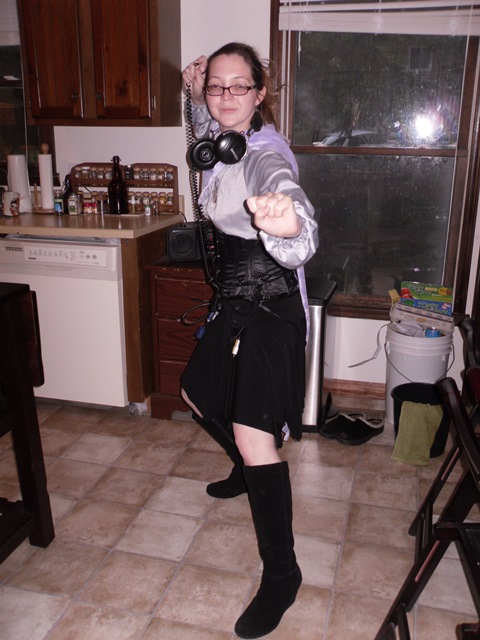
10-minute hero

10 Minute Hero:
Wired!
Maybe you've heard of the 10-minute hero challenge. It goes something like this: you have 10 minutes, exactly 10 minutes, to transform yourself into a hero with whatever you have on hand. Then you get someone to take a picture.

 "Yeah, right," you say. "Do I look like a hero to you?"

Well, yeah.

See, in my way of thinking, you are a hero. Maybe I don't know you. Maybe you don't think you're very brave or heroic. Maybe you live a life of complete obscurity in a remote island, plotting to take over the world.

But you're someone's hero. Are you a parent or a child's guardian? Then you are sun, moon, and life a child. You are the one person standing between that kid and the universe. What about a pet owner? Same deal. You hung the moon in the sky.

No? Not a parent? Well get this. You're still the one person who stands between an ordinary citizen and disaster. You see, at some point, you'll have a moment of unrelenting awfulness.
Yes, you'll experience something in your life you JUST DON'T
WANT TO DEAL WITH. And you'll do it anyway.


Gee, thanks. Is this supposed to be a pep talk?

 See, we all live through tough times. It's part of being a person. But the fact that you take the time to deal with it makes you someone's hero--because when someone else goes through a bad time, they'll be able to look to you for an example. You survived. So can they.

"Sheesh, wearing my big-girl panties makes me a hero? I think you're confused, lady."

Okay, not convinced? How about this: Have you ever done something nice for someone?

We're each other's first line of defense. Humans are made to look after other humans--it's that instinct, the desire to run towards disaster, that baffles scientists and makes biologists scratch their heads. Altruism exists. And any time you help someone for no reason whatsoever, you're being someone's hero.

Maybe you don't feel like a hero. But just by smiling at a stranger, by letting someone in during rush hour, by tipping the kid who delivers your pizza an extra $5--you've just made someone's day. You've just made the world better for one single person. And that is how the world is made better.

"I'm never nice to strangers."

Well, you're a tough case, aren't you? But you just revealed something in your subtext: You're there for your friends. Let's make this perfectly clear: your friends are humans (or at least they pretend to be). By standing by them, you're a hero to them. Have any of your friends ever called you at midnight after a big breakup? Or been thinking about quitting something loved, and you talked that friend into keeping going? That's what a hero does.

You don't have to run into a burning building to make the world a better place. You're a hero just as you are: Someone who cares about other people, even when they can't do something for you in return. Someone who makes the world just a little better. That's what being a hero is all about.

So go prove your heroics. You have exactly 10 minutes. Assemble whatever is closest at hand and dress yourself as a superhero. Then get a roommate, cohabitant, or autotimer to take your picture.

What's your 10-minute hero name?


Sidekick kitty wonders if Superhero Wired has any
tuna up her sleeves.

Friday, February 1, 2013

Conquering fear: Tornado in my closet

I used to be terrified of tornadoes. Lightning? Pretty. Thunder? Sky-bowling. But quick-moving winds? I remember one year at summer camp, a storm moved in rapidly. The clouds scurried across the sky so quickly you didn't have to sit still to see them move, and the afternoon grew twilight dark. Wind whipped through the trees and tore free leaves that fluttered down, spiraling and dancing and as bright green as they'd ever been. I crawled under a table and wouldn't come out.There may have been a few tears and little incoherent whimpering.

A camp counselor got on her hands and knees to tell me there wasn't even a tornado watch. It was just a fast-moving summer storm.

I didn't move until it was gone. Any clouds moving that fast had to be driven by cyclone-power, regardless of what the weathermen said.

There wasn't, off course, any tornado. But having grown up in the South in an area where tornadoes aren't an uncommon threat, having a phobia of them isn't unusual. I could stand spiders with minimal squealing and chair-hopping, but tornado watch? Send someone to pry the kid out of the game closet. Heck, I'd share a crawl space with spiders if I had to.

As I got older, I got better about ignoring the fear. Play it cool, I'd say to myself, and get through the day by blatant denial--turn off the radio and get lost in schoolwork, or turn on the TV to a news channel (in retrospect, probably a giveaway because it was the only time I was the one to flip to the news channel, but my parents never called me on it) and pretend to be  reading a book instead of watching.

One night in high school I had two nightmares. In the first, I was trapped in a hotel in which a tornado was bearing down on us. Had a lovely view of it coming our way from our 20th story room with a wall-to-wall window. I ran out into the hallway to find some windowless room to hide and encountered a chestnut stallion, possibly the most beautiful horse I'd ever dreamed up. I grabbed his halter and tried to pull him with me to safety, to get him to the stairs so we could go to the basement (I'm thinking it was a slow-moving twister when out of sight?). He was spooked, though, and I woke up as things started to fly.

Well of course that put tornadoes on my mind. So when I fell back asleep, no surprise my next dream featured a tornado bearing down on my house. I ran and hid in the coat closet, squeezing in between the vacuum and spare table leaves, stepping over the bag of gloves and hats, and ducking under the coats to protect my face from possible flying objects. (Since I had plenty of waking experience with this, that part of the dream was rather realistic.)

But then in my dream I decided I wouldn't accomplish anything by hiding. So I stepped out of the closet just as the tornado reached the house and blew into the hall (oh dream physics, how you defy logic). Rather than running from it, I put on full bluster and began to scream at it (How dare you, tornado!). I scolded that twister so thoroughly it twisted up with shame and shrank, and finally ducked into the closet to hide from the terrifying human. At some point it had acquired a face that now began to droop and sag and wince, and in true Harry-Potter boggart fashion I completed the picture by giving it a pink-and-lime hairdo and a handbag.

I woke up feeling powerful and exhilarated. I had defeated the tornado! Go me, go me, strike a pose and victory dance.

If only shaming tornadoes worked in real life.

But after that dream, my knuckles stopped turning quite so white when the clouds blew in, and if I still twist an eye up to the sky now and then during tornado watches, it's just a twinge of persistent nervousness, not gut-clenching fear. Tornadoes are something worthy of being a bit nervous about, if you ask me, so a little careful awareness isn't uncalled for.

These days I rather enjoy storms. If the news says I don't have to worry about major damage, I'll spend a summer storm on the covered balcony watching the clouds roll by and the lightning flash. Sometimes I'll feel a bit of uneasiness if the wind is too strong, but then I remember a tornado with pink-and-lime hair, and that the weathermen really do know what they're talking about, and I can go back to watching.

There's something about taking control that diminishes fear, at least for me. It's why I mock the scary movies that scare me the most, because it gives me power over them. It's why boggart-fighting works for me, because making my fear ridiculous gives me control over it, and that makes it less terrifying.

It's why I can do things in my real life that scare me, such as following the dream of becoming an author, such as submitting queries knowing I'll probably get many rejections before I find an agent: because I can remind myself that what I write is within my own control, and that I can improve. It's why I can attempt any major life change: because if any plan doesn't work out, I can do things to mitigate the damage, such as save money beforehand, have a back-up plan, and have friends on call to talk me through the down times.

I can't control other people, and I can't scold tornadoes into closets. But I can promise myself that I  have many options if my first choice doesn't work out, and then take advantage of those options, because I only lose if I give up, not if I take a different street to store. Knowing I can change my path, even if I don't, gives me choices, which is a form of control, which gives me courage. So, afraid or not, I put the pink-and-lime hair on my most terrifying challenges, and then I face them.

I'll never fully stop being scared. But I don't have to hide in a closet, either.

What's a fear have you faced? How did you get through this fear?

Monday, January 14, 2013

Conquering Self-Doubt

We're not robots. That's why we do things like burn out, get tired, need support. Like writing: even knowing you're a good writer, and that an agent passed not because of your writing quality but because of her personal tastes, you probably (if you're like me) have a flash of self-doubt. "It wasn't good enough; I must be terrible!" Then reason kicks in, and whacks you across the back of the head.

Knowing something isn't true doesn't stop you from feeling it in the first place.

This isn't limited to writing.

Relationships: He didn't want to go out.
Gut reaction: I'm awful and no one will ever date me.
Truth: He thinks I'm serious relationship material and he's not looking for commitment. There are other guys who are better for me.

Weight: I weigh more than the women on TV that everyone calls pretty. I weigh more than models.
Gut reaction: Oh dear goodness, I'm fat!
Truth: Fashion portrays women unrealistically (and unhealthily). I'm healthy as I am, and should remember that their body shape would be unhealthy in me. 

Interviews: I got an e-mail saying the position was filled.
Gut reaction: I messed up the interview; no one will ever hire me!
Truth: They already had someone else in mind/someone else was more qualified. I'll have another chance at the next interview.

Cooking: The rice burned.
Gut reaction: I'm a horrible cook and I'll never know how to make good rice!
Truth: I haven't made this brand of rice before and am still learning the best way to make it. Next time will be better.

Positive thinking is a powerful tool. Not only does it reinforce the positive, but it reminds us (by its existence) that everyone else feels doubt too. 

There are things that are our fault, actual problems that we can fix. If I'm five pounds over where I want to be, I can go on a diet and exercise more, and change it. If I burn the rice once, I can figure out why, and next time not burn it. When something really is a problem that we can fix, then we should.

But we can't control other people. And if we always spend every hour of our lives changing ourselves to please others, we'll never know who we are. Our gut reaction is to assume that something we can't (or shouldn't) change must be a sign that we suck. But the gut lies. It's okay to make mistakes.

When you feel bad because something didn't turn out as you hoped, remember that it's natural to have a negative gut reaction. But also remember that self-doubt doesn't control you. Call your gut on the lie. If it's something you can fix, then fix it. Otherwise, figure out what the truth is, give yourself a positive statement to negate the self-doubt, and move on.

What does your gut lie about? What's the truth? And what's something good about yourself?

Friday, January 4, 2013

Take Yourself Seriously, and Laugh

Do two things for yourself this year: Take yourself seriously, and laugh.

If you're a scientist, or an artist, or a mathematician, or a game-writer, make time for learning or making something new. Make time for doing something you love, that which got you into your profession in the first place. Invest in yourself, as in set time aside for these things. Why? Because it's professional development, because it's motivation, because it keeps you from getting burnt out. Because whether or not you ever get paid for it, it's part of your job, and more importantly: part of who you are.

And if you're a writer, make time for writing. Understand that writing is a profession: A "pay on completion" job. Okay, sometimes you won't get paid, but that's no different from any other art-related job. Writing has a very long production period, but it's still a job. A job you love, and a job you will sometimes have to fight to keep, but a job.

Don't forget that. You're making an investment. Even if you don't earn money from it, you'll have earned experience. And whatever you do, don't despair. Everyone doubts herself sometime. But the difference between self-doubt and despair is whether or not you keep going.

Remember to laugh. Connect with people. Online or in person, connecting with others in the same field gives you a support community. Community, as in people who care about you, who share laughter and stories and their most terrible adventures and funny pictures of cats, dogs, and parakeets.

So laugh, because remembering those moments will be what carries you past self-doubt, what keeps you working towards completing your work. Those are the moments worth working for, the moments worth living for.

In this new year, take yourself seriously, and laugh.

What's something fantastic that happened last year?

Monday, December 17, 2012

Motivation: Don't blame, just fix

I remember an incident when I was a kid, where there was a mess in the family room. Mom walked in and told my brother and me to clean it up. "It's not my fault!" we both cried.

"I don't care whose fault it is. Just clean it up."

Wisdom in a nutshell.

"It's not my fault that I can't write today; my husband forgot his lunch, so I had to take it to him." "My boss won't let me go home early." "The computer is too slow; it drives me crazy and stops me from writing." "My Facebook friends keep messaging me, which distracts me from writing." All of these statements are ways of assigning blame.

But that's a problem, because blame does nothing. Blame is the excuse not to do something. Nothing I do will ever be complete if I focus on figuring out whose fault it is that I've got an obstacle in my path.

Instead, if I want to be productive, I focus on fixing. Is there a problem? What is the problem? Then how can I fix it?

"My husband forgot his lunch and can't eat out, so I'll take him lunch, but he's in charge of dinner so I can make up my writing time." "My boss won't let me go home early, so I'll make time this weekend." "My computer is slow, so I'll run an anti-spyware program." "Facebook is distracting me, so I'll post a status message saying that I'm off to do some writing, and disconnect the Internet."

A huge motivator for me is to never state a problem out loud unless I tack on a solution. It doesn't matter whose fault the problem is--in fact, I try to actively avoid assigning "fault," because it distracts me from my purpose: Fixing the problem. 

(I try to do this in editing, too: if I have a problem with a passage, I state what the problem is and offer a possible solution.)

Because when we focus on fixing, we get things done. It's a completion-oriented thought process, and like most psychological things, how we view the world affects how we interact with it. So when I make a habit of focusing on solutions, I put myself in a can-do state of mind, which means I'm more likely to get things done despite challenges.

So instead of getting mad at someone else for stopping you from writing, try focusing on the problem: You're not writing enough, and you don't have time to do more writing. Then formulate a solution: Ask someone else to watch the kids for an hour three days a week; use a cloud-based writing platform that allows you to write on your work break; rope your Facebook friends into helping you write more by starting a 1k1hr session.

Sometimes it's tempting, when faced with a solution that I cannot fix, to just assign blame and move on. It's an easy way of handling it, because I don't have to stress. But the thing is, it still doesn't accomplish anything, and the problem still exists. 

For example, no agents have requested MANUSCRIPT X.That's a problem. An easy blame would be "traditional publishing is terrible and agents are all evil," or "I'm a bad writer with no talent and I should just give up." Not my fault, nothing I can do. But it doesn't fix anything.

A better way to address this is to address the things I can control. I cannot make an agent like my story. But I can: A) improve my query through thorough editing, B) find other agents to whom my story would appeal more, C) take a query-writing class to get professional advice, D) analyze the market to figure out if my manuscript is a niche product, and if so, make connections in the niche community and then self-publish, E) put the manuscript aside for a few years and focus on writing/selling a second until the first is back in vogue, F) decide I have the resources available to go it on my own, hire an editor and a cover artist, learn how to effectively promote my book, learn the best practices of self-publishing, and then self-publish, or G) realize trying to publish isn't going to make me happy, and take up a hobby instead.

All of those are solutions I can implement. They all solve the problem, and yes, they all require effort from me (except possibly giving up). They all motivate me, because I can accomplish them, because they are things that I can actually do. Whose fault is it that MANUSCRIPT X hasn't been requested: mine, the agents, the editors, the book-buyers, maybe E.L. James for stealing all the customers' book money? I don't care.

What I care about is what I can do.

To me, blame is useless. It doesn't matter whose fault a problem is. The only things that matter are the problem, and the solution. And it's putting myself in that mentality that helps me become more productive. 

Does solution-oriented thinking motivate you? Has blame (or being blamed!) ever stopped you  from accomplishing something you wanted to do?

Monday, September 3, 2012

Motivation: What Keeps Me Showing Up

It's why we show up to work every day. (Motivation: paying rent.)
It's why we eat dinner at night. (Motivation: hunger.)
It's why sometimes we make dinner even after a 10-hour day instead of nuking a bowl of oatmeal. (Motivation: delicious food.)
It's why we skip dessert. (Motivation: still fitting in pants.)
It's why we start writing. (Motivation: quieting the stories in our heads so they'll leave us alone.)
And it's why we finish writing.

But where does that motivation come from? Sometimes we do things just because we want to. Other times, we have to drive ourselves by finding external drivers.


External vs Internal Motivation

I blog every Monday, Wednesday, and Friday. I do this for the motivation of establishing a routine, in hopes that when I am published, I will continue this good habit. Blogging regularly (theoretically) will increase my readership and show my readers I appreciate them. This is a reward-based motivation: external. It's my long-term motivation.

I also blog because I enjoy it. Every blog I post gives me a chance to put my words out there. This is an internal motivation: I do it because I get an emotional reward.

I began researching publishing news because I thought it might be helpful to the other authors I've networked with, and continued researching because it also helps me grow, too. That's also an internal motivation: I like the feeling of knowing I'm improving.

And when I've posted blogs, sometimes I see the page views go up. Post, look at page views, go away, come back later and see the numbers have gone up. (Squee!) That's an external motivation: post, and see readers visit (reward-based.)

Most things we do provide both external and internal rewards. I water the plants on my balcony every day so they don't die (external), and I have plants on my balcony because I like smelling flowers and having live plants (internal). The same goes for writing: no matter how much we love it, we also get rewards for it.


Choosing Rewards

An important factor to motivation is figuring out what is rewarding for you. Do you blog because you like seeing your audience grow and leave replies? Then you may be more externally motivated, and your rewards should probably be external motivations. Or do you blog because you like the feeling of having posted a blog, even before someone reads it, because it gives you a sense of accomplishment? Then you're probably internally motivated.

Okay, probably both. So how to tell the difference? Ask yourself, "How do I feel when I make a post no one reads?" (In other words, how do I feel when I don't get the reward?) If the answer is "Frustrated, because what's the point if no one reads it?" then you're probably better off rewarding yourself with external rewards. If the answer is "Disappointed, but whatever. I posted it and that's what matters," then you're probably internally motivated.

For people who respond better to external motivations, you'll want to give each of your short-term accomplishments some kind of external reward. These don't have to be expensive or even indulgent. "I get to post on Facebook what kind of progress I made" is a good example, because it's a reward you cannot get without achieving your goal (I suggest joining a group of writers who encourage each other, so you don't annoy non-writers or slow writers with constant posts about your word counts!)

Reaching your goal may usually seem like reward enough. But sometimes it isn't, and when you're bashing your head against a writers' block, a little external motivation can go a long way. Don't be afraid to use it. We're human, and that means sometimes we get frustrated and need an extra push.


Choosing Motivators


"One day I'll publish and make a million dollars" might seem like a great motivator, but in actuality, it's not. Why? Well, for one thing, it's unrealistic. It implies that writing is easy (it isn't), and that an author is likely to make millions (we're not). So when the motivator is proven fallacious, the desire to keep writing falls.

The long-term motivation for a writer may be to publish, may be to say "I finished what I started," or might just be to finally find out what happens at the end of the book. But a long-term motivation is a long-term goal, and we write in the short-term, on a day-to-day basis. "One day I will publish" turns into "One of these days, I'll get around to writing."

So we need to make motivators for ourselves to accomplish our goals. Often the internal motivation "writing is fun" isn't enough, because writing isn't always fun: it's hard work, and sometimes leaves us pulling out our hair or making forehead-friends with writers' blocks. And there are days where we're just too busy to lend an ear to the storylines that chase us, so that doesn't fill the bill, either.

What we need are short-term motivators with sharp, clear-cut guidelines. First, decide what needs to be accomplished. Then choose definable steps to accomplish them. Every time you reach one of these mini-accomplishments, you get a reward.

Sometimes the motivation is a short-term goal. Sometimes it's the possibility of getting a reward (or punishment), and sometimes it's just the desire not to look like you've been lazy. But what it always is, is something that holds us accountable.


Motivator Examples
  • Daily or Weekly Word Counts
  • Deadlines
  • Joining a weekly writers' update group
  • Feeding your hungry beta-sharks readers
  • Making a promise
  • Getting a provisional offer
  • Being accepted as a member of a group
  • Allowing yourself to read a book for meeting a goal
  • Telling your mother what you did in the last week
  • Competing with a rival
  • Telling someone else you're going to do something

What motivates you to keep writing? When do you find yourself needing an extra push, and what rewards do you give yourself?