Wednesday, July 30, 2014

Book Bonus: Creating the Broken Powers World

Developing worlds is one of my long-time hobbies. So it may not be a surprise to you that there's a lot to the Broken Powers world, alternate-Earth setting of Into the Tides, that doesn't begin to show up in the novel.

Beyond Madison, WI; the Tide Zone; the oil platforms outside LA; and a few abandoned towns and cities, there's an entire thriving world. Yes, the devastation of the American South affected even countries beyond the borders of the US, and badly. Prices of many goods went up dramatically, and people across the globe mourned the loss of the highly international population of the Southeast. Nor was the physical destruction limited to the US: the Bahamas were entirely consumed by magic, and much of Cuba as well (including Havana). International aid supports what remains of Cuba, with Venezuela acting as the primary relief force (with help from China and Russia) providing stability to the survivors and making loud announcements of ensuring the US continues to respect the sovereignty of the small island (The US government, of course, continuously reiterates Venezuela's vocal protection is unnecessary, but sincerely thanks them for their humanitarian relief efforts).

But new cities have been founded, such as Sanctuary, KS. As people flocked inward, away from the coasts, they sought land-locked areas and set up shop. Sanctuary's gone from a virtually (or not-so-virtually) nonexistent town to a thriving metropolis, as Boston and New York and San Diego residents swarmed to a place of supposed safety. Carefully monitored from the very beginning by the architectural firm (who bought the land cheap and sold the homes and business locations at a huge profit), it's got grid-like city planning; due to demand residents for the city proper are only sold homes if they can prove employment. So of course, the sprawling suburbs of the areas not formally owned by the original architectural firm teem with the hopes and dreams of the less settled, and in a reversal of modern stereotypes, it's the suburbs where danger thrives and schools beg for funding, while the inner city schools are renowned for their excellence, and walking alone at night in the alleyways is safer than skirting a white picket fence.

Many people also chose to travel west, avoiding not coasts in general but primarily the East Coast. Most were absorbed into local cities with ease, thanks to the emmigration of other residents, although the city of Redshirt in the mountains south of Eureka, in northern California, began as a terrace-farming experiment and grew popular with artists, engineers, the film industry, and people looking for places to conveniently disappear without abandoning civilization as a whole (the number of caves in the area being highly conducive to a new--or rather, very old--kind of settlement).

A the time of the beginning of the book, New York, Boston, and other East Coast cities have begun to recover some of their former glory. For a while, the rising poverty (as wealthier residents who could afford to do so moved away) and high levels of vacancy led to high crime. However, large businesses were reluctant to entirely abandon their significant investments in land and building space, and the states began offering better incentives to stay, which meant that while some left the areas, others moved in. Thus, poverty took a nose-dive over the course of the past three years between the Tides happening and Into the Tides beginning. City parties and an emphasis on job creation and public morale have also helped the areas re-grow; employment is easy to find; good housing is cheaper than it's ever been for the areas. Crime, after an initial rise, has hit all-time lows. Thus, the residents who drifted away out of prudent fear have begun to settle back, deterred by high unemployment in more populous (and popular) regions. 

So how did all these places get planned, if they didn't show up in the novel? And why?

Creating new areas for the world means thinking about implications and reactions. People want to go here, I think, and then wonder, but what does that mean for the area they're leaving? And for the places they're going, considering how they're leaving? Is there infrastructure? Are people planning? It goes on from there.

I also just like to create new areas. It's, well, fun. After all, I'm the sort of girl who writes 10+ page backstories for her D&D characters, and creates fantasy languages for amusement. 

Plus there's the possibility of making the areas open for fans to enjoy. I've thought of making a tabletop roleplaying system to go along with the world (again, my idea of fun), and part of that is creating areas that are both fun to exploit--er, "live in"--an fun to build, so I keep desiring to add more and continuously grow the world. 

What are your favorite parts of tabletop settings? Do you enjoy creating worlds of your own? What's best about it?

Monday, July 28, 2014

Monday morning geekery: The appeal of new toys

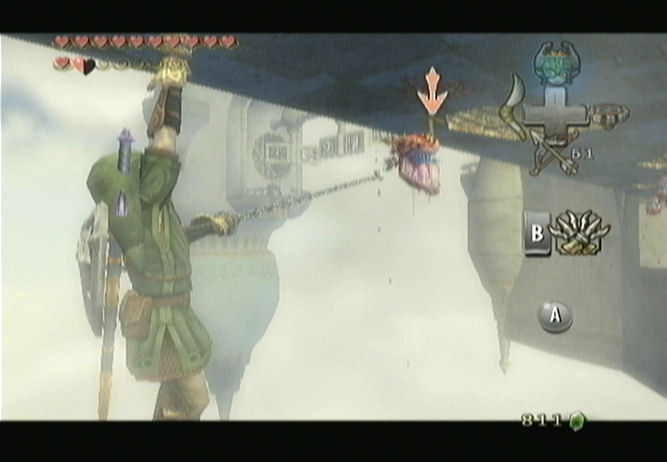
(Image from Zeldadungeon.net)
Double clawshots in action. Wheeeeeee!
I'm replaying Twilight Princess (no surprise to those of you who know I'm a Zelda series fan), and got the double clawshot after finishing the City in the Sky dungeon this weekend (after a nice long day of unpacking, cleaning, and hauling stuff around).

Thus began a night of running around completing sidequests and finding double-clawshot hideaways and pieces of heart. You know, as one does when presented with a new toy in a video game. It's been nearly a month since I'd last played, so of course I had to put some extra effort into side-questing.

Of course, being a month since I'd had the chance to play, it wasn't until the very end of the night, staring down the throat of the portal to the Twilight world, that I remembered my Dominion Rod had been fully charged. And I hadn't found and ordered around all the statues in the world yet.

No, Midna, I'm not going to go defeat that enemy for you. I've got more sidequests to do. What, we probably shouldn't leave the portal open and unguarded? Pssssh, it'll be fine. If there's one thing my adventures in my many lives in time have taught me, it's that enemies always wait until you're done sidequesting to make any major moves.

But that reminded me, as I headed off to sleep, that I still don't have the mirror shield yet. I mean, really. It's an awesome item. Why doesn't it come until the end of the game?

The problem with gaining items through questing is that some of them don't come until nearly the end. One of the things I enjoyed about A Link Between Worlds (the Zelda game where you get to turn into a 2D piece of artwork... in game, that is) was that you could get all the items right off the bat, so long as you spent your time collecting money to rent them. All the fun things! All the nifty things! All the toys with which to play! Mwahahaha! (*cough cough* er, please excuse the evil laugh; just clearing my throat. Wait--put down that Master Sword!)

The problem with really cool items is that they usually come far too late in the game. You want to spend hours playing with them, and keep imagining how they could have been used in earlier dungeons. Yeah, sure, you can go back and use them, but... not the same.

The double clawshot, for example--SPIDERMAN ITEM. Why couldn't you give them to me at the beginning and let me spiderman around Kakariko Gorge or Death Mountain from the very start? Link's feet would never have touched the ground! It would have been so much fun!

What games have fun items that you don't get until much too close to the end, that you would have preferred to have the chance to use earlier? What are the items you wished you could have had the entire game, that really deserved more uses than the game incorporated?

Friday, July 25, 2014

Publishing Industry News

This week's publishing news and industry blogs post covers 7/5-7/25.


Publishing News

Amazon offers a $9.99 subscription service for audio and e-books, much like Oyster and Scribd. Sort of like a library, except you pay, and also don't have to leave the house.

A proposal hits the Senate to make the Marketplace Fairness Act and the Internet Tax Freedom Act into a single bill, the Marketplace and Internet Fairness Act. The bill receives support from senators in both parties.

Simon & Schuster now enters negotiations with Amazon. (Most likely unrelated to the Hachette dispute--Amazon often discusses terms with publishers.)

Conan Doyle's estate is appealing the verdict that declares Sherlock Holmes officially public domain.

The RWA launches NovelEngagement, a free romance book app to help readers connect with and discover authors. (Yes, disclaimer, I'm a member of RWA.)

Apple has decided to settle in the Apple vs DOJ damages trial, but Judge Cote has hinted that she's not okay with the timeline of the proposed settlement.

Google defends its right to display snippets of works in searches as fair use in the Authors Guild vs Google bookscanning case.

Wattpad upgrades to support Creative Commons 4.0 licenses, meaning fans will have the ability (with works with the option selected) to reshare and even remix other works into new ones, enabling the option to allow fan fiction among other things.

Smashwords releases the results of its third annual reader survey about indie e-books. The Smashwords blog analyzes the key findings, including the decline in effectiveness of pricing the first ebook free.

And Hugh Howey releases an Author Earnings report for July 2014, of the same style as his February reports, with this one based on the top 120,000 Amazon best-sellers.

In France, retailers can no longer offer free shipping on discounted books.

According to the Authors' Licensing and Collecting Society, the average UK author salary is down 29% from 2009.


Industry Blogs

QueryTracker's Publishing Pulse for 7/4, 7/11,  and 7/25.

Nathan Bransford posts The Last Few Weeks in Books for 7/18. He also gives some good advice for young writers.

More opinions on the Hachette-Amazon dispute: Victoria Strauss weighs in on the Amazon vs Hachette and author letters "discussion." Author Douglass Preston starts a new letter, and a group of authors create "Authors United" to show support. Amazon VP of the Kindle division responds to his letter with an offer that Preston refuses on the grounds it hurts Hachette far more than Amazon. The Authors Guild weighs in.  (Publishers Weekly posts a digest on the many opinions.)

Agent Suzie Townsend answers questions: What number of rejections should tell you that you need to revise strategy? How do you choose comp titles?  Also, she offers an example of a query that worked.

Agent Janet Reid answers questions and gives advice. Is buying/winning/etc a critique from an agent actually likely to put the agent off from your work, as opposed to a standard query? (No, winning a charity auction won't hurt your chances. Really, it's not. Plus, charity=good. But don't expect it to give you special treatment, either [beyond the critique].) Do you need a platform when querying a novel? Should you start building one now? (No.) If you know someone in a publishing house that doesn't accept unagented queries, is it okay to send something to them for an "in"? (No; for a place that doesn't accept unagented works, get an agent.

And more from Reid. The contact will be good for you once the agent is shopping the manuscript.) Your agent says the big houses have all rejected your manuscript and she doesn't want to shop it anymore; what now? (Ask if she'll review a contract if you shop it yourself to small publishers, etc) A friend has drawn art for your book. Should you send it with the query? (No.) You're giving your first manuscript unto the dust bunnies and focusing on number 2; but is it okay to print a couple copies of #1 for close, personal friends? (Don't do it. You never know where it could end up.) An ex-literary agent offers to critique... for $1000 bucks. Worth it? (Highly doubtful. Why isn't this person still an agent?)

Yet more from Reid: When should you start going to conferences? (Depends on conference, but Reid suggests after finishing the first book.) Yours is the only book that focuses on shark compulsive editing; how do you find a comparison? (Look more generic. Try "Shark Ailments") You have two books ready to query; do you wait on #1 before querying #2? (No, but it's complicated.) An agent lists things she doesn't represent but you're not sure if your ms counts; should you query? (Er on the side of querying when unsure.) Your first book is published with a small publisher; will this hurt the chances of the second? (A bit, yes.) Is it okay to query a work under a pen name and another under a real name at the same time? (Query one work at a time.)

A good reminder from the Editor's Blog: it's not "cheating" to use writing tools that exist to be used. Don't feel guilty for using something made to be used.

On Writer Beware (now with a new look and layout), Victoria Strauss warns writers to avoid Green Shore Publishing. And she talks about her own experience with fake bad reviews (bad reviews written by anons with the sole intent of bullying, intimidating, or harassing the author) and how she dealt with it.

Agent Nephele Tempest posted a link to writing opportunities for August and September, which I'm unabashedly yoinking and sharing with you all.

Fraser Sherman (member of one of my writers' groups) posts a nice selection of helpful and interesting writing links.


What other major publishing news has hit the shelves in the past 3 weeks?

Wednesday, July 23, 2014

If Tides were a tabletop RPG...

If you've played a tabletop RPG, such as Dungeons and Dragons or a GURPS setting, you're familiar with the concept of classes--basically, the roles the characters fill in the adventuring party. Basically, their jobs.

Should there ever be a Broken Powers world tabletop RPG, I've been wondering what classes it might have.

I think I'd have to divide classes into Powered or unPowered, with different advantages to each. A possible set might be:

Powered:
  • Utilitarian Power (flight, heat, cold): This covers sixth- through third-class Powers who work in jobs where their magic is used as a tool. They have mechanical prowess and general survival skills. They have regular employment (not necessarily government), but cannot achieve much fame, although they may have hobbies that can add extra income. They are fairly socially adept and can have minor social influence.
  • Military Power (strength, illusion, travel, etc): This covers Powers of all strengths whose magics are used in the military. Although they may not all engage in melee, they will be familiar with weaponry and basic fighting and self-defense techniques, and probably have concepts of strategy. While they're good at physical survival, they're less well adapted to society. The pay is less than privately employed utilitarian Powers, but they likely have their basic needs taken care of by the government.
  • Specialized Power: This covers Powers who have advanced degrees and use their Powers for specialized technical jobs. They may have specialized knowledge, but are likely inept at fighting. While their specialization may give them some social status, outside academia or their particular realm of expertise they're unlikely to be known. They may, however, have a social network of powerful contacts or sponsors behind them.
  • Investigative Power: This covers high-level Powers who are employed by the government. They have the highest degree of influence, as they are agents of the government; however, they are also the most highly regulated. They have mandatory but steady employment, and strong magic; because the government takes care of them, they may not have the best day-to-day survival skills.
unPowered:
  • Entertainers: This covers people who are in any part of the entertainment industry. Players will choose the performance or medium the character specializes in. The characters have high levels of skill in this art and can become famous for their art, obtaining a high degree of social influence and accumulating a lot of wealth. They may also develop a social network of powerful contacts, and are generally well-liked by the public, and are usually adept at moving through all strata of society.
  • Politicals: Politicians, lobbyists, social activists--all people who specialize in building power and influence. Generally but not always wealthy, their greatest assets are in getting things done. Few, however, are well-liked by the public.
  • Skilled Workers: People who have regular jobs. Although they have little influence or wealth to begin with, they are very skilled at a variety of tasks, and may have any level of education.From mechanics to doctors, they're capable and competent, and can get almost any job done. They learn quickly and are good at just plain getting by.
  • Law-breakers: People who get their income by less-than-legal means, such as thievery, drug dealing, or cons. They're great at manipulating people, and most are decent at fighting. Survival is their specialty, and some are reasonably wealthy. However, they have no political influence, and have to stay below the eyes of the law.
  • Military: Great at fighting and usually capable of taking care of themselves, these people tend to be fairly skilled in a variety of areas. They have less political influence and wealth than other professions, but have more than Powered military personnel, as well as more personal freedom. They also have some degree of government power, depending on rank.
I'd probably come up with more--have to figure out what assets there are, and what each class can contribute to an adventuring party. But it's sure fun to think about.

Monday, July 21, 2014

Big boxes, little boxes, lots of boxes

(Image from skrewtape on Wikimedia commons)
Surprisingly accurate.
Lots of boxes, everywhere.

No internet or floss yet at the new place.

No clothes or bed at the old the place.

Top of the table is at the new place; table legs are at the old.

Somewhere in the new place are two kitties, thrilled about the boxes. =^.^=

Just your standard, everyday move.

Friday, July 18, 2014

What we can learn about novel writing from D&D backstories


(Image by Rocco Luigi)
Playing D&D
You probably know by now, I play Dungeons and Dragons and other tabletop, dice-rolling RPGs, such as d20 Modern and some GURPS (generic urban role playing system). Although the game mechanics between these game systems are different, the general idea is the same: have character. Sit with a bunch of geeky people (preferably that you like) and hang out being generally silly together, usually with food at hand.

It's a pretty sweet setup. And it's taught me a lot about character design.

Take backstory. "Backstory," if you haven't heard the term, is the story of your character's life before the game started. Sometimes it's as simple as "She's a dwarf locksmith who never quite fit in, having engaged in the occasional session of off-duty lock picking, and was chased out of the caves, and now is wandering the world trying to find something to do."

Other times, it's a twenty-page story filled with angst and sorrow. (*cough, cough*--the danger of letting writers write backstories

But in either case, across all tabletop RPGs, I've noticed a theme: After sharing the background with the game master, you rarely share more than a line or two about your backstory for the first adventure, sometimes even for the whole game. And sometimes not even a line or two.

What the other players need to know is: 
  • how they met your character (the game master usually supplies this)
  • how your character acts
  • what party role your character plays (rogue, fighter, healer) and how good your character is at it
  • how your character fights/what weapons and abilities they have
  • whether or not they can trust your character
  • whether or not their characters like yours
  • (to a very vague extent) what your character looks like
That's about it.

In the best campaigns, the game master will work at least a piece of your backstory into the main story. Your character's background will actually matter, in some way. But until it happens, you're not likely to talk about your character's background with the others during general play, except during a conflict. You'll certainly not introduce your character by what he or she did before the game started.

And the story of the game rarely suffers for this.

What can writers and storytellers take away from this?

Stories don't need extensive background brought up until conflict makes it relevant

What you need is to introduce your characters' abilities (with no more background than is needed to understand the abilities). You need introduce your characters to each other and establish how they interact (through dialogue, both verbal and nonverbal). And you need to introduce enough of the setting that the reader understands what is going on--the setting, if it's an unusual world or area, is in a way much like a character.

To discover more about your characters, conflict needs to arise. For an important conflict, dropping hints through an early nonviolent/low-stakes conflict introduces a hint of the backstory. Later, a larger conflict brings the details out in force.

But only when it's relevant is backstory most effective.

I've played games with 20+ pages of background information on the character, and no one but the game master ever read or heard of any of it, because the focus of story revolves around the most interesting character conflicts. If one character is related to the bad guy, then that character's story will be the best known, and at the end of the game, we'll all know the entire relationship, from childhood abandonment to being raised by wolves. Meanwhile, the rest of us will share sparse details--kicked out because I picked one too many locks off-duty; sent to destroy evil by my temple; ex-soldier looking for work now that the army's been disbanded. Maybe a few references to old friends and advice picked up on the way (had a brother-at-arms who was eaten by a wolf that summer of battle. We all starting using wolf repellent, and not another one of us was eaten), but they're situation-appropriate, and more about building character and making interactions more amusing than elaborating on actual backstory. 

And you know, most players are usually all fine with this.

Because the story is where the conflict is, and the adventure is where the conflict is, and as long as we're all having fun and interacting, where we were before the story doesn't matter. The game is in the interaction between people. Not in what goes on before the story begins.

There are games where there ends up being one main protagonist. Other times, every character is equally important, and everyone winds up knowing everyone else's background. But that's determined by the conflicts. And the most interesting stories?

They're the ones with the most interesting conflicts.

So whenever possible, introduce backstory through conflict. You need some context, but once the foundations are laid, make backstory sparse and relevant. Because what the readers want isn't what happened before the story began--what they want is what happens during the story.

Wednesday, July 16, 2014

Book Bonus: Tidbit: Kelly meets a tutor at Mechany's

To get back on schedule, and also to help me during packing and moving, the Publishing News post will be next Friday, not this one.

----

The protagonist of Into the Tides, Kelly, is a tone-deaf woman who inherited music magic (called a music Power). Because of her tone deafness, when her Power emerged at puberty, she couldn't use it; after a few years of trying to help her themselves, her family sent her to a special boarding school that helps youngsters who have problems with their magic.

Kelly, age 17, starts her first year at Mechany's. At the end of the first week, the students without mentors are interviewed by tutor-researchers (most of whom are grad students), who in exchange for the opportunity to study abnormal magic development will offer one-on-one additional tutoring to students. During Kelly's session, twenty-seven researchers looking for "projects" interview the thirty-eight new students.

"I have a learning disability in magic. I'm a little... dysfunctional."

The woman in the lab coat nodded encouragingly, looking more comfortable in the narrow classroom desks than I felt. This was her natural environment, after all: observing students. Then again, she couldn't be more than twenty. She was probably a student herself half the time. "My notes show you have a music Power," she commented.

I nodded. "Fourth class, if I'm like my dad. I want to do what he does, one day--go to clinics and sing away pain from the patients."

She scratched a note on her paper. "Admirable. It's a good use for music magic. So what sort of problems do you notice with your magic?"

Beside us, a twelve-year-old appeared a foot above the ground, upside down, and plummeted to the floor, feet barely missing my head. I jumped up with a little shriek.

"Sorry," he said, and sat up and waved at a guy in a lab coat on the other side of the room. "Every time I sneeze," he called. "Although only sometimes upside down."

I sat down, watching him jog back to the researcher. He definitely had a tutor--the researcher watched every step avidly, the eager light in his eyes full of acquisitive joy.

My partner's lips pursed. "Probably got the kid to do that on purpose," she muttered to me. "He's such a show off. And travel Powers always get the most attention in terms of a thesis. But who's it gonna help?"

I folded my hands in my lap. "My dad had a rock band for a while," I said. "He's really good. If he wasn't Powered, he'd probably have become a star. We've been trying for years, but even he can't get my magic to work right."

Her attention came back to me. "So it's a resilient problem."

I nodded.

A girl about fifteen or so jumped up, whapping at her desk with a heavy-looking yellow-and-black blanket. She'd carried it in with her despite the 80-degree weather, and at the time I'd thought the black patches were some strange dyework.

The room was otherwise quiet while she put out of the flames with a few well-placed blows, everyone watching. Finally, the man in a lab coat who'd prudently backed a few feet away walked over to stare at the smudges. "These desks are supposed to be pretty much fireproof," he commented with an even tone. "I think you warped it."

She sighed, flopping down into the seat and rubbing at the smudge with a corner of the blanket. "Sorry."

He smiled and clapped her shoulder. "Not at all."

I cleared my throat, and my partner reluctantly tore her eyes from the scene to look back at me. The bite of plastic pinching my fingers told me I was fiddling with the fish bracelet around my wrist, so I stopped. "Once, when I was fourteen, I tried to hum my brother's headache away, only I ended up making him fall asleep instead, and he didn't wake up for almost twelve hours."

Her polite smile drooped a little. "Um. Anything else?"

"Well, when Mom was editing a book, I tried singing her a song to help her focus. After about three minutes she said she really had to pee, and she couldn't concentrate for most of the night."

"That's, uh, interesting." Her gaze slid down to her clipboard. "What, exactly, do you know about your problem?"

I was fidgeting with my bracelet again. "I'm tone deaf."

"Tone deaf."

"Yeah." Lacing my hands together so I'd keep them still, I stared at her, hoping.

She didn't look back up at me. "A tone-deaf music Power. And you've had no unusual, special abilities manifest? Just ordinary things?"

I shook my head. "Usually I can't get my magic to work at all. But nothing a normal music Power couldn't do."

"Well, it's sort of an obvious problem. Easy to identify. And fourth class is... I mean, it's nice. Not the strongest level of magic, though."

The plastic fish on my bracelet seemed to swim around in my vision, and not by any magic or trick of the light. I squeezed my eyes and willed them to stay dry.

A woman on the side of the room shouted in surprise, and a young girl apologized.

"The school is really very good at addressing cases like yours," my partner said. "I just don't think you'd need me. You understand, right?"

I nodded. Again.

The sound of heels on linoleum told me she was standing up. "I really think you'll be fine," she added. "They're professionals, the regular teachers. Really good at what they do. And it's such an obvious problem, I'm sure there's an obvious solution. They'll have you good to go in a year, I bet. Maybe two."

Her heels clicked away, and I heard her mutter something about a blind illusion Power and smells.

None of the other researchers stopped by my desk. Not that year. Not the next. And not the year after that, either, even though I still hadn't managed to make my magic work.

My magic was broken, but not broken enough.

----
Tone-deaf Kelly has long considered her inborn music magic to be useless. But after a disaster drowns the American South in magic, including her whole family except her twin brother, she discovers her “useless” magic lets her hear the voices of those lost. Now, with the help of her twin and her handsome, green-eyed neighbor Derik, she’ll face magic itself to save them–only the attempt may cost her everyone she has left.