Showing posts with label book bonus. Show all posts

Wednesday, December 10, 2014

Book Bonus: Possible Jobs for Illusion Powers

Illusion magic in the Broken Powers world alters perceptions. People with illusion magic, illusion Powers, can also perceive when perception is altered, including due to things such as colorblindness or deceit. To learn more about what illusion Powers can do, you can see the full description here.

Avery Cannon is a fifth-class illusion Power. She works as a detective, using her ability to perceive when others are seeing things differently, or seeing things she cannot. Although she can't see these things herself, she can use her magically-enhanced instincts to question those around her until the source of the difference becomes clear. Of course, what the person sees may not always be important. She also paints, using her illusion magic to sketch the image before she draws it to help her achieve what she's going for.

Dax Powell is a fourth-class illusion Power. With his ability to see through another person's eyes (with their permission), he works as an eye doctor. This allows him to diagnose more easily vision problems, and help patients, especially those with trouble communicating, achieve the correct prescription. Although as a Power he's paid less than most ophthalmologists, his work with the poor and disabled gives him tax and rent subsidies through the local Powered HQ, so he actually has nearly the same buying power as his un-Powered peers. He and his wife have recently planted a small vineyard on their property--a benefit to an hour-long commute being the large lot of land at a relatively low cost--and rent it out for weddings while the crops establish themselves. Although his magic doesn't show up in the photography, couples have been known to pay a little extra for a little "touch of magic" in the ceremony and reception. These tend to be obvious illusions, such as a glowing bride or stars or images on a screen; for as a fourth-class Power he can only create illusions "with awareness"--people know the illusioned objects have been altered in some manner.

Martha Powell, Dax's wife, is a third-class illusion Power. She works as a sketch artist for the local police department, using her illusion abilities to create and adjust an accurate image of the perpetrator based on the victim's descriptions and reactions. Once the sketch has been perfected, she draws it as closely as possible, often from multiple angles. She also sometimes puts on magic "plays" for visiting children, using her magic to create movies against a flat white screen.

Andrea Bordeaux, a second-class illusion Power, works for the FBI. Much like Avery, she investigates and uses her abilities to discover things she couldn't see on her own; unlike Avery, this may include using the eyes of someone near her (with their permission) to spot exactly what's important or different. She is also sometimes brought in for investigating and/or rescuing rogue illusion Powers, her magic giving her an extra buffer against second and even first-class illusion Powers' ability to alter perceptions without awareness (meaning even when no one else knows when something is an illusion, sometimes she can sense that it is). When she's not working, she usually knits or goes hiking. She also keeps 3-4 blank, framed canvasses in her home, and likes to create "paintings" on them based on places she's been when she has guests over.


Tone-deaf Kelly has long considered her inborn music magic to be useless. But after a disaster drowns the American South in magic, including her whole family except her twin brother, she discovers her “useless” magic lets her hear the voices of those lost. Now, with the help of her twin and her handsome, green-eyed neighbor Derik, she’ll face magic itself to save them–only the attempt may cost her everyone she has left.

Wednesday, November 12, 2014

Book Bonus: Possible Jobs for Music Powers

Music Powers have magic that allows them to perceive the world in a new kind of detail, and that also affects peoples' emotions. In Into the Tides, Kelly's father was a traditional music Power, and although she was born tone-deaf, she too was considered a music Power. You can find more about what, exactly, music Powers of different classes can do here. Some possible jobs music Powers might have could include:

Janette Callahassee is a fifth class music Power. She's a member of the US Air Force, working as a mechanic, and uses her perception abilities as part of identifying where the planes she works on need fixing. She can hear pings and rattles below the threshold of most humans' perception, and with her perfect pitch she is able to rule out several incorrect possible causes long before her fellow mechanics could. This makes her an effective and valuable member of the repair team, allowing her team to work more efficiently. She also volunteers to help soldiers being treated for PTSD, using her magic to soothe them and reduce the symptoms of hyper-arousal that cause them to be constantly on edge. This can often lead to improved sleep, better adjustment to social settings, and other benefits that can greatly help the soldiers. In her free time, Janette spends time with her kids and husband, and enjoys listening to music herself.

Clark Mayhew is a third class music Power. He works as a psychologist, in conjunction with a pair of psychiatrists who often prescribe music Power services. His typical workday is split 50-50 between counseling patients of his own and using his magic to treat patients based on prescriptions of his partners (and occasionally independent psychiatrists). Some of the time he works with groups of 3-5 patients with similar emotional needs, calming anxiety and helping his patients address their concerns in small group settings, which helps keep costs down for low-impact patients. For patients with more private issues, he offers one-on-one music/counseling combinations. In order to maintain his Powered license for counseling, a full quarter of his clientele are pro bono cases assigned to him by the local Powered headquarters, which pays him a rather small stipend in compensation. During his free time, he acts in a community theater that advertises Powered performances. His magic enhances the emotional impact of the performances, and he has a somewhat devoted following of Powered theater enthusiasts--a niche audience, but a supportive one.

Howard Ronaldo is a second class music Power, working for the US government to help enforce trade regulations. He is part of an inspection team for international facilities to ensure the companies follow labor guidelines, from preventing child labor to enforcing safety regulations. His wife, a fifth class strength Power, acts as his bodyguard during his frequent travels, with their teenage children safely at home in the care of their grandparents. Howard's enhanced hearing allows him to detect lies more easily, and to hear suspicious sounds during inspections, leading him to have uncovered several "cleaned-up" operations that had tried to hide violations during inspections. Due to the precarious nature of his job, many of his off-hours while traveling are spent either being wined-and-dined by various business owners (he's not allowed to accept gifts, however) or playing cards with the other members of his team in secure hotels. At home, he can at least kick back and relax, playing tag football with his son at a local park, or going on hikes.

Chiomi Alegi is a first class music Power who works in the Veterans Affairs department, visiting several veterans' hospitals as a medical musical assistant who provides drug-free pain relief through music. Although as a first-class Power she technically has enough magic to cause harm, her training has been extensive, and she has never caused a casualty. In her off-time, she writes fantasy short stories, and has had several published. She also enjoys cooking with her husband, and their three children frequently find excuses to avoid eating their parents' various experiments.


Tone-deaf Kelly has long considered her inborn music magic to be useless. But after a disaster drowns the American South in magic, including her whole family except her twin brother, she discovers her “useless” magic lets her hear the voices of those lost. Now, with the help of her twin and her handsome, green-eyed neighbor Derik, she’ll face magic itself to save them–only the attempt may cost her everyone she has left.


Wednesday, October 29, 2014

Book Bonus: Pinterest character boards

Housekeeping note--This week's Publishing News post will be delayed until Monday, on account of running around acting like a ghost (or whatever Halloween costume I come up with in the next couple of days).

So what's new?

I'm on Pinterest!
Why yes, one of my first stops was making
a tea board. Why do you ask?


You can find me here.

I've started making character boards for the characters in Into the Tides, consisting of things they'd pin if they were on Pinterest.

So far I have Elizabeth and Kelly. More to come!

Also, some boards of my own, because there's lots of cool stuff there!

Wednesday, October 15, 2014

Book Bonus: Jobs for Cold Powers

Cold Powers in the Broken Powers universe have a magic that prevents them from becoming overheated, and are able to lower temperature of other objects. You can see the detailed list of their capabilities here. What are some examples of jobs they might hold?

Eileen Nguyen is a fifth class cold Power. She lives on the outskirts of Las Vegas, and works as a SBI agent, specializing in desert investigations. Because of her high, magical tolerance for heat, she has a lower need for water, and is unlikely to suffer from prolonged exposure to the desert heat. When desert stakeouts are needed, she's usually the one sent. Needless to say, she also spends a lot of time working out, training to stay physically fit. As with many magic users, government-based jobs pay more than private institutions, including in medicine; as such, Eileen's salary provides the majority of the household income. Her husband, a fourth-class cold Power, currently works part time an emergency care clinic as a heat stroke and fever specialist, a job to which he'll return in a couple of years. For much of the day now, however, he's the primary caregiver for their infant and toddler.

Rutherford "RC" Collins is a third-class cold Power. He works at a nuclear power plant, using his ability to insulate up to three of his coworkers from heat when checking potential hot spots. He can't shield people from radiation, but he can reduce pockets of air or water in temperature to prolong a person's survivable time. He can also channel cold into metal bars to speed cooling of heated liquids. Although he would be more effective touching the material bare-handed, for safety purposes he remains in a full protective suit. After hours his hobbies are calmer; he plays baseball in a non-competitive Powered exhibition league (where players are encouraged to safely show off their magic in the game for the entertainment of the watchers).

Antoinette Marshalle is a second-class cold Power. She works in medical research with the CDC. Hazmat suits are very uncomfortable in Atlanta, except when one can keep herself cool; she volunteers for clunky suit duty frequently. Her magic also comes in useful for preserving specimens; she carries special boxes lined with metal that freeze quickly, and that she can keep frozen. When she's not working, she roots for her favorite sports teams, and also practices karate twice a week.

Fargo Goldsmith is a first-class cold Power. He works in Powered investigations, specifically on a team tracking down rogue and endangered magic users. Many of those on the run seek extreme locations where isolation serves to keep them hidden; Fargo and his team use their abilities to find them and neutralize (or rescue or otherwise help) them. Like many high-class Powered, he takes advantage of the government's strongly family-friendly policies, using his leave time to spend with his family, from volunteering in classrooms to attending ballet recitals to taking the kids camping.


Tone-deaf Kelly has long considered her inborn music magic to be useless. But after a disaster drowns the American South in magic, including her whole family except her twin brother, she discovers her “useless” magic lets her hear the voices of those lost. Now, with the help of her twin and her handsome, green-eyed neighbor Derik, she’ll face magic itself to save them–only the attempt may cost her everyone she has left.

Wednesday, October 1, 2014

Book Bonus: Jobs for heat Powers

Heat Powers in the Broken Powers world have magic that prevents them from getting cold. You can find the full list of their abilities here. While the strongest heat Powers can start fires, most have more limited capabilities. Here are some jobs a heat Power might have.

Susanne Moggletop is a fifth class heat Power in Montana. She works in a factory, producing electricity by creating convection currents that spin turbines, with the help of no fewer than six other heat Powers. The factory, which produces plastics, gains more use from her limited magic this way than if she were to try melting the plastic directly, mostly because she wouldn't be able to do so on a practical scale, or even with all the plastics the company produces. Because the job tends to be tedious, she unwinds by 4-wheeling with her husband and kids on the weekends. As with many people in monotonous jobs requiring continuing use of magic, she has developed exceptional endurance with her magic, which comes in handy when she decides to go one of her many winter camping trips.

Darvene "Stone" Hamilton is a fourth class heat Power in Alaska. He mans search and rescue teams, helping his teammates keep their core body temperatures high and, when necessary, treating  hypothermia by slowly and safely raising the temperature of rescue subjects. On his time off, he volunteers in schools, teaching kids and newcomers basic winter survival skills. He's always welcome company, with keeping people warm being a cheap party trick, and so weekends find him the life of the party. Like most Powered, he doesn't drink; but a good designated driver is always in demand, and so his truck almost never goes without a free oil change or new tires, and if he never seems to make it to the grocery store, he also never seems to have an empty pantry, either.

Alyson Sarrano is a third class heat Power from Tuscon, Az. Although the Arizona weather wouldn't seem particularly pleasant to a heat Power, as it stops her from getting cold but not hot, the optics industry is booming, and any cheap, sustainable source of electricity that cuts down on pollution while avoiding steep fuel import costs can't help but be popular. Alyson generates convection currents for a factory, doing herself what it takes six to eight fifth-class Powers to do together. She's also a hobby herpetologist, keeping about a dozen snakes (not venomous) of various sizes as pets. Since the snakes enjoy the heat she emanates, it's a fairly happy family; but since she doesn't like to scare the neighbors, she's very careful about whom she invites over.

George Hammelstein is a second class heat Power headquartering in the Northeast. Working for the FBI, he tracks murderers trying to flee the country (or simply crossing state lines). His magic allows him to operate even in winters that send most other people hunkering down. Those counting on snow to cover their tracks don't last long against the man who never stops hunting.

Eline Devos is a first class heat Power. Career Navy, she doesn't call any town home, preferring to think of the sea as home. While the specific heat of water makes the Pacific too cold for even most heat Powers to be comfortable for long, as a first class she can dive for up to three hours wetsuit-free in near-ice without discomfort, so long as she doesn't go too deep. As such, she specializes in salvage and rescue missions, which occasionally benefit from the higher dexterity of bare hands. The dangers of the ocean go far beyond the cold (her magic doesn't give her gills, or protect her from jellyfish), so she focuses on her job most of the time. When she does relax, it's the tune of watching black-and-white monster movies with her friends.


Tone-deaf Kelly has long considered her inborn music magic to be useless. But after a disaster drowns the American South in magic, including her whole family except her twin brother, she discovers her “useless” magic lets her hear the voices of those lost. Now, with the help of her twin and her handsome, green-eyed neighbor Derik, she’ll face magic itself to save them–only the attempt may cost her everyone she has left.

Wednesday, September 24, 2014

Book Bonus: Into the Tides trivia!

Trivia Time!

When they're bad, they're bad:

One rule I tried to follow throughout the book was that Kelly does not know how to fight. Ever. It's not something she's studied, and so she sucks at it every times she tries, which is why it was important to pair her up with two physically capable characters: Elizabeth and Derik. The only fights she shows any talent with occur in the Tides, where the video-game logic of the Tides (unbeknownst to the characters) plays in their favor.

Had Kelly tried to fight a seal by closing her eyes and jumping at it with a knife anywhere else, well, she wouldn't be fighting extinct seals, so it's probably a moot point. However, she doesn't have anywhere near enough combat expertise to realize her luck.

Lost Goods:

In the beginning of Chapter Two, Derik is dressed for a meeting in a button-up cotton shirt. Earlier drafts of the story described the suit as having an "American cotton" undershirt, as the American cotton industry became crippled after the Tides struck. Indian cotton, as of the beginning of the story, is more typical and far cheaper. The explanation was eventually cut for length, which meant the descriptor also had to be removed.

Dogs or horses?:

The horse trailer Valdez gets for his stowaways used to be a kennel for hunting dogs, before a little research showed just how cramped a truck bed kennel would be!


A cameo:

In Into the Tides, there's a scene at the beginning of Chapter Twenty with a book called The Dragon Reborn laying around. This was actually added in during the edits (there was a different book, originally) I'd been thinking about the Wheel of Time series, and skimmed through several of the books trying to figure out which one had the first, best references to the dream world, which in terms of surrealism have some similarities to the Tides. I then started re-reading the Wheel of Time series (... and have stalled out on book 8, to no one's great surprise).

Smarter than he sounds:

Valdez is actually one of my own favorite characters, although his appearance in this first book is relatively light compared to the backstory (never introduced in the actual novel, sadly). His accent wasn't one he was born with. Growing up in Austen, TX, he had a slight Texan accent, but got rid of it in his first year in undergrad. However, by the time he got into Yale, he'd discovered emphasizing his accent made people underestimate him--giving him an advantage in the courtroom as a contract lawyer. However, working in a field that often left him looking for exploitative loopholes burnt him out quickly. He joined the Army Reserves four years in, moving to a smaller firm in Madison, WI, whose main clients are nonprofits.

After the Tides, like most of the Reserves, he was placed on active duty for Recovery missions. In the three-month intervals when Recovery missions aren't possible, he's allowed to return to his normal job. Because he spends so much time on the missions, he primarily helps others with their case loads. He still affects the Texan accent, except when stressed enough to forget it. Other peoples' stereotypes often work to his advantage.

Although it's not directly mentioned in the book, after the trip south, he's removed from active duty for the rest of the Tide cycle, and is taking advantage of the not-so-voluntary vacation for some counseling (at the recommendation of his commanding officer) and some actual R&R.


Tone-deaf Kelly has long considered her inborn music magic to be useless. But after a disaster drowns the American South in magic, including her whole family except her twin brother, she discovers her “useless” magic lets her hear the voices of those lost. Now, with the help of her twin and her handsome, green-eyed neighbor Derik, she’ll face magic itself to save them–only the attempt may cost her everyone she has left.
Wednesday, September 17, 2014

Book Bonus: Travel Powers Jobs

Travel Powers have a teleportation-like skill that allows them to move faster. See what exactly they can do here.

James Ottosparrow is a fifth class travel Power. He works in a mine, where his ability to sense objects in the dark helps him map out new areas and ensure the structure of older areas. While being able to sense obstructions doesn't provide fine details, it's enough to avoid running into walls or missing a crevice. He works with earth Powers to construct a safe working environment for the other miners. In his free time, he volunteers at a community theater, managing props and handling the stage lighting.
Travel Powers can usually outrun their foes,
unless their foes have cars or horses.
Then the travel Power waves goodbye,
just like everyone else.

Giovanni Ross is a fourth class travel Power. He works for the FBI, investigating international crimes. While travel Powers are not encouraged to work in espionage, criminal activities, especially those that cause human suffering. Saving people through investigation and being able to move quickly--or sense people within forty feet--give him an advantage in the field. His partner is always willing to make sure his uncontrolled skips occur in safe environments, pelting him with ping-pong balls at unexpected moments.

Sara Nyugen is a third class travel Power. Her ability to skip without interference allows her to enter the planes she works on without removing paneling, performing maintenance on hard-to-reach areas. She's part of her local live action roleplaying group, as well, where in addition to participating in the LARPs, she sometimes helps the game masters at night, monitoring for trouble and helping LARPers recover lost items.

Marra Adeyemi is a first class travel Power. She works for the government, of course: investigating rogue Powers and bringing them to justice (or, if needed, rescuing them). She also helps handle diplomatic relations between the Powered community and those without magic, paying damages and settling wrongs caused by magic. Unlike many Powered, her hobbies have nothing to do with magic: she and her husband share a passion for music, and relax by flute and violin.


Tone-deaf Kelly has long considered her inborn music magic to be useless. But after a disaster drowns the American South in magic, including her whole family except her twin brother, she discovers her “useless” magic lets her hear the voices of those lost. Now, with the help of her twin and her handsome, green-eyed neighbor Derik, she’ll face magic itself to save them–only the attempt may cost her everyone she has left.
Wednesday, September 3, 2014

Book Bonus: Sample Jobs for Telekinesis Powers

Some Powers have obvious jobs, such as regeneration Powers, who become doctors and medics. Others, such as telekinesis Powers, have a less obvious career path, and find themselves useful in disparate fields.

Jerald Mayers, a third class telekinesis Power, works in an army warehouse, where he stores and retrieves crates via magic, and occasionally rescues falling things from landing on peoples' heads. With magic, he can shift around crates and loose items that are inconvenient to reach, saving time when crates in the back or on the bottoms of stacks take damage.

Lucinda Wong works at a steel factory as a fourth-class telekinesis Power. She works with the machinery that handles hot steel, from checking the grip of mechanical arms to replacing parts in the machinery, even moving small cameras over the machinery for trouble shooting. With her magic, she minimizes the time spent waiting for metal to cool before problem-solving, and helps ensure no person has to approach the metal while it remains at burning temperatures.

David Goldsmith works construction as a fifth-class telekinesis Power. His magic can't lift much weight from a great distance, but he can operate some equipment remotely, although for safety reasons he only operates push-button items that require no steering or supervision. This eliminates activating cranes, which might swing wild or strike objects he couldn't see, but includes pressing elevator switches or opening doors when everyone has hands full. With his ability to "see" obstructions behind himself, he can walk backwards without fear of falling or running into things--nice with two-person hauling jobs. His magic also allows him to "handle" dangerous objects, such as live wires that escape hands, by pinning them down until they can be safely retrieved; and delicate jobs, such as setting wires in hard-to-reach areas.

Stacey Martins, a first-class telekinesis Power, works in the military on an explosive ordinance disposal task force. Diffusing explosives might be terrifying work, but when robots cannot provide a careful enough touch, with a good camera image, she can work with dexterity at 40 feet, employing up to ten "hands." When not on emergency diffusing, her unit works full-time in demining. Her unit is often called on to clear areas near civilian locations, or areas where people would like to settle but that have been historical war sites. Once mines are located, she can remove them from the ground at a safe distance, keeping all personnel out of the potential blast zones, or if necessary remotely detonate them. 


Tone-deaf Kelly has long considered her inborn music magic to be useless. But after a disaster drowns the American South in magic, including her whole family except her twin brother, she discovers her “useless” magic lets her hear the voices of those lost. Now, with the help of her twin and her handsome, green-eyed neighbor Derik, she’ll face magic itself to save them–only the attempt may cost her everyone she has left.

Wednesday, August 27, 2014

Sample jobs of strength Powers

Most strength Powers are in some branch of the military. Those that aren't, are sixth class or government agents of another kind. Fifth-class strength Powers or stronger are not eligible for police work, except on contract basis such as with SWAT teams.

Enrigo Martinez is a fourth-class strength Power. He works with the US Department of Justice as an adviser on Powered interests. Although a strength Power, he rarely uses his magic, instead spending his time researching current events related to the interests of strength Powers, providing expert testimony to the Supreme Court and the District Courts. With the rest of his family in the Navy or the Army, he's well-motivated to advocate for their rights. Even if family gatherings tend to be mildly volatile.

Anna Higuchi, a third-class strength Power, is a member of the Coast Guard. A big fan of tabletop roleplaying games, she relaxes with her friends between patrols rolling dice and playing a hero. Since her duties involve activities such as rappelling down to stranded boaters and rescuing them from the middle of hurricanes, it's not too different from her regular work, although she does enjoy the lack of official paperwork and the fewer periods of extended boredom on most patrol days. For one month out of every year, she leaves her unit to work full-time at the PT center, helping keep her fellow Guard members in peak condition.

Janet Singh is a second-class strength Power and an officer in the Army. Her work revolves entirely around fitness: as a member of the Army, she helps train recruits and reserve-duty members, including those needing extra help to achieve the necessary physical conditioning for duty. Although not usually a drill sergeant, she can act as one when needed; most of the time she moves from squad to squad, providing rotating supplemental conditioning.

Louis Martinelli is a six-class strength Power. Although working in the public sector provides him a choice of occupations, the demand for strength Powers is high enough that he doesn't regret his employment as a security guard for a bank. In his younger years, he worked as a male model; now that he's in his fifties, he enjoys the steadier work of deterring crime through being friendly to customers, while also being very muscular. He boosts his income by hiring himself out as a workout partner at the gym he visits, which helps keep him in this rather intimidating shape.

Amelia Martins is a fifth-class strength Power in the Navy, where she works as an IT specialist. While much of what she works on during the day is classified, she also designs web games after hours, and is an active member of the local SCA. She hasn't decided whether or not she plans to marry or have kids, nor will stating such a preference enhance or diminish her career now that it's started: for a modern government that wants to strongly encourage the growth of the strength Power population, providing ample opportunity and excellent family benefits has shown better results than direct interference, with far less legal cost.

(Wondering what strength Powers of each class can do? Here's a detailed chart on what, exactly, their abilities are for each class level.)


Tone-deaf Kelly has long considered her inborn music magic to be useless. But after a disaster drowns the American South in magic, including her whole family except her twin brother, she discovers her “useless” magic lets her hear the voices of those lost. Now, with the help of her twin and her handsome, green-eyed neighbor Derik, she’ll face magic itself to save them–only the attempt may cost her everyone she has left.

Wednesday, August 20, 2014

Book Bonus: Possible jobs of 3rd class flight Powers


Eleanor Gatsby is a third class flight Power.

As a third class flight Power, she can completely reduce her weight at will, and can reduce her acceleration to 1 ft/s/s without trying. When she focuses her magic, she can control the speed at which she falls, and fly for 30 continuous minutes with a maximum speed of 20 mi/hr. She has to rest for a half hour afterward, but because she practices on a daily basis, she's built up a lot of endurance, and can get airborne 4 times before needing a longer break to recover.

Usually after the fourth trip, she needs a couple of hours to really catch her breath, although she can take a shorter flight after a half hour.

 So what does she do for a living?

She works with a telephone company, specializing in power line repair. Using special equipment, she corals live lines (staying well clear of them--by no coincidence, she's great with chopsticks) and flies them out of roadways and other areas that might endanger people. She also helps hang new power lines, her flight ability meaning she accomplishes the job quickly and never has to worry about falling. Flight Powers are in high demand with utility companies for these attributes, and are often part of first-response teams when storms knock down cables.

Her cousin Marcus Smythe is also a third class flight Power. Marcus works as a park ranger in a national park in the Midwest, adding aerial patrols to the rangers' regular ground patrols. He helps search for lost hikers, keeps an eye out for poachers and troublemakers, and helps monitor wildlife populations; however, his most important job is spotting forest fires before they get out of hand. Flying over slowly the park, he's spotted smoke from three wildfires before they spread, allowing the ranger team to contain them with minimal damage and redirect them to controlled burns when needed.

Their aunt, Deborah Evans, meanwhile, is a third class flight Power working with the fire department. Although the fire hose has too strong of a kick for a single fireperson to control, three flight Powers working together can hold it steady mid-air. Working together, they can also lift several of the lighter fully-suited firefighters, helping them down from upper floors when passageways become blocked. Most often, the flight team secures emergency ladders for trapped inhabitants to get to safety from higher levels, or check for toxic fumes in high-ceiling areas where other firefighters cannot reach. They also sometimes rescue cats from trees, although they do that more often off the clock than on.

LaKeisha Tanner was licensed at the same time as Deborah, but she chose a different route: she's an FBI agent. Although her first- and second-class colleagues must work for the government, many less powerful magic users also choose the position. LaKeisha's flight ability means she can approach suspects from the air, at an angle they usually don't expect; of course, there's less cover in the air, but a good sense of tactics has kept her safe so far. She can also reach locations other agents can't during stakeouts and other investigations. When her duties keep her on the ground, where she performs much as any other FBI agent, after hours she and her fellow agents keep in shape at their local headquarters' aerial obstacle course, sometimes with super soakers (when their lead officer isn't around).

----

Tone-deaf Kelly has long considered her inborn music magic to be useless. But after a disaster drowns the American South in magic, including her whole family except her twin brother, she discovers her “useless” magic lets her hear the voices of those lost. Now, with the help of her twin and her handsome, green-eyed neighbor Derik, she’ll face magic itself to save them–only the attempt may cost her everyone she has left.

Wednesday, August 6, 2014

Book Bonus: Studying the Lost

In the Broken Powers world, what agencies are there that examine magic and the Lost?

Kelly, a tone-deaf Carolina woman who tries to use her music magic to protect her remaining loved ones while investigating the Tides that entrap most of her family, notes in the novel that surely some of the Lost must have been experimented on at one point or another. The Lost are all that remains of the inhabitants of the South, animal-like creatures that are cold to the touch.

And she's perfectly correct.

Investigations began from the American Powers HQ, located in New York. This agency, in addition to overseeing licensing and certifications for Powers, being the central office of Powers in law enforcement, and coordinating requests for help from Powers, also oversees research into the nature of magic.

Powers HQ helps fund and archive data from places such as Mechany's, researching magic and helping those with magic control their Powers. They also maintain a database on magical anomalies, the better with which to treat--or neutralize--magic problems.

This includes cases when magic traps an entire region of the country, and the results thereof.

During the first High Tide, some Lost wandered into border areas such as Memphis, TN. Many were rounded up by animal control. Those who were did not fare well as the Tides flowed out, leaving the Lost stranded too far from magic; the ones who were not released died. Most were, however, allowed to leave, as those mourning the loss of their friends and families spread rumors that the Lost might be somehow related to getting them back.

Meanwhile, the Powers HQ sent teams down for research. More than 40 Lost were rounded up, blood samples drawn, and their physical and magical reactions measured. First through fourth class Powers reported hearing voices from the creatures, senseless babbles; third class and higher Powers reported also seeing visions of various things, most related to panicking.

When the Lost thus monitored were found to be affected by the retreating Tide, they were either released or the research stations moved.

Of those that moved too close to the Tides, the inhabitants of three simply disappeared. Notes seemed to indicate the subjects of the research had not been treated well, having been subjected to more extreme "tests."

Experiments continued to be conducted by teams staying within the Tide Zone all the way up through the beginning of Into the Tides. Scientists involved (most fifth class or lower, or unPowered, as higher classes found the Tide Zone nearly unbearable for long periods of time) focused on attempting to interpret the babble and visions and discover the natures of the Lost. No progress was made in understanding the creatures' babble or vision.

Under a microscope, samples from the Lost frequently lost structure and evaporated, rarely surviving long enough for real study. Most progress was made studying pictures taken within the first fifteen minutes of taking the samples. Since the Lost were by that point considered patients, they were treated with some consideration for their comfort, although confinement was required for consistency of subjects.

A few unsanctioned groups, including amoral scientific groups, rogue cults, greedy medical corporations, and curious criminal elements, conducted unsanctioned experiments in border areas during High Tides (those who entered the Tide Zones disappeared, with rumors of terrifying monsters called Hunters spreading). The fates of the Lost who were studied depended on the group.


-------------
Tone-deaf Kelly has long considered her inborn music magic to be useless. But after a disaster drowns the American South in magic, including her whole family except her twin brother, she discovers her “useless” magic lets her hear the voices of those lost. Now, with the help of her twin and her handsome, green-eyed neighbor Derik, she’ll face magic itself to save them–only the attempt may cost her everyone she has left.

 Available now on: 
Kobo  

Wednesday, July 30, 2014

Book Bonus: Creating the Broken Powers World

Developing worlds is one of my long-time hobbies. So it may not be a surprise to you that there's a lot to the Broken Powers world, alternate-Earth setting of Into the Tides, that doesn't begin to show up in the novel.

Beyond Madison, WI; the Tide Zone; the oil platforms outside LA; and a few abandoned towns and cities, there's an entire thriving world. Yes, the devastation of the American South affected even countries beyond the borders of the US, and badly. Prices of many goods went up dramatically, and people across the globe mourned the loss of the highly international population of the Southeast. Nor was the physical destruction limited to the US: the Bahamas were entirely consumed by magic, and much of Cuba as well (including Havana). International aid supports what remains of Cuba, with Venezuela acting as the primary relief force (with help from China and Russia) providing stability to the survivors and making loud announcements of ensuring the US continues to respect the sovereignty of the small island (The US government, of course, continuously reiterates Venezuela's vocal protection is unnecessary, but sincerely thanks them for their humanitarian relief efforts).

But new cities have been founded, such as Sanctuary, KS. As people flocked inward, away from the coasts, they sought land-locked areas and set up shop. Sanctuary's gone from a virtually (or not-so-virtually) nonexistent town to a thriving metropolis, as Boston and New York and San Diego residents swarmed to a place of supposed safety. Carefully monitored from the very beginning by the architectural firm (who bought the land cheap and sold the homes and business locations at a huge profit), it's got grid-like city planning; due to demand residents for the city proper are only sold homes if they can prove employment. So of course, the sprawling suburbs of the areas not formally owned by the original architectural firm teem with the hopes and dreams of the less settled, and in a reversal of modern stereotypes, it's the suburbs where danger thrives and schools beg for funding, while the inner city schools are renowned for their excellence, and walking alone at night in the alleyways is safer than skirting a white picket fence.

Many people also chose to travel west, avoiding not coasts in general but primarily the East Coast. Most were absorbed into local cities with ease, thanks to the emmigration of other residents, although the city of Redshirt in the mountains south of Eureka, in northern California, began as a terrace-farming experiment and grew popular with artists, engineers, the film industry, and people looking for places to conveniently disappear without abandoning civilization as a whole (the number of caves in the area being highly conducive to a new--or rather, very old--kind of settlement).

A the time of the beginning of the book, New York, Boston, and other East Coast cities have begun to recover some of their former glory. For a while, the rising poverty (as wealthier residents who could afford to do so moved away) and high levels of vacancy led to high crime. However, large businesses were reluctant to entirely abandon their significant investments in land and building space, and the states began offering better incentives to stay, which meant that while some left the areas, others moved in. Thus, poverty took a nose-dive over the course of the past three years between the Tides happening and Into the Tides beginning. City parties and an emphasis on job creation and public morale have also helped the areas re-grow; employment is easy to find; good housing is cheaper than it's ever been for the areas. Crime, after an initial rise, has hit all-time lows. Thus, the residents who drifted away out of prudent fear have begun to settle back, deterred by high unemployment in more populous (and popular) regions. 

So how did all these places get planned, if they didn't show up in the novel? And why?

Creating new areas for the world means thinking about implications and reactions. People want to go here, I think, and then wonder, but what does that mean for the area they're leaving? And for the places they're going, considering how they're leaving? Is there infrastructure? Are people planning? It goes on from there.

I also just like to create new areas. It's, well, fun. After all, I'm the sort of girl who writes 10+ page backstories for her D&D characters, and creates fantasy languages for amusement. 

Plus there's the possibility of making the areas open for fans to enjoy. I've thought of making a tabletop roleplaying system to go along with the world (again, my idea of fun), and part of that is creating areas that are both fun to exploit--er, "live in"--an fun to build, so I keep desiring to add more and continuously grow the world. 

What are your favorite parts of tabletop settings? Do you enjoy creating worlds of your own? What's best about it?

Wednesday, July 16, 2014

Book Bonus: Tidbit: Kelly meets a tutor at Mechany's

To get back on schedule, and also to help me during packing and moving, the Publishing News post will be next Friday, not this one.

----

The protagonist of Into the Tides, Kelly, is a tone-deaf woman who inherited music magic (called a music Power). Because of her tone deafness, when her Power emerged at puberty, she couldn't use it; after a few years of trying to help her themselves, her family sent her to a special boarding school that helps youngsters who have problems with their magic.

Kelly, age 17, starts her first year at Mechany's. At the end of the first week, the students without mentors are interviewed by tutor-researchers (most of whom are grad students), who in exchange for the opportunity to study abnormal magic development will offer one-on-one additional tutoring to students. During Kelly's session, twenty-seven researchers looking for "projects" interview the thirty-eight new students.

"I have a learning disability in magic. I'm a little... dysfunctional."

The woman in the lab coat nodded encouragingly, looking more comfortable in the narrow classroom desks than I felt. This was her natural environment, after all: observing students. Then again, she couldn't be more than twenty. She was probably a student herself half the time. "My notes show you have a music Power," she commented.

I nodded. "Fourth class, if I'm like my dad. I want to do what he does, one day--go to clinics and sing away pain from the patients."

She scratched a note on her paper. "Admirable. It's a good use for music magic. So what sort of problems do you notice with your magic?"

Beside us, a twelve-year-old appeared a foot above the ground, upside down, and plummeted to the floor, feet barely missing my head. I jumped up with a little shriek.

"Sorry," he said, and sat up and waved at a guy in a lab coat on the other side of the room. "Every time I sneeze," he called. "Although only sometimes upside down."

I sat down, watching him jog back to the researcher. He definitely had a tutor--the researcher watched every step avidly, the eager light in his eyes full of acquisitive joy.

My partner's lips pursed. "Probably got the kid to do that on purpose," she muttered to me. "He's such a show off. And travel Powers always get the most attention in terms of a thesis. But who's it gonna help?"

I folded my hands in my lap. "My dad had a rock band for a while," I said. "He's really good. If he wasn't Powered, he'd probably have become a star. We've been trying for years, but even he can't get my magic to work right."

Her attention came back to me. "So it's a resilient problem."

I nodded.

A girl about fifteen or so jumped up, whapping at her desk with a heavy-looking yellow-and-black blanket. She'd carried it in with her despite the 80-degree weather, and at the time I'd thought the black patches were some strange dyework.

The room was otherwise quiet while she put out of the flames with a few well-placed blows, everyone watching. Finally, the man in a lab coat who'd prudently backed a few feet away walked over to stare at the smudges. "These desks are supposed to be pretty much fireproof," he commented with an even tone. "I think you warped it."

She sighed, flopping down into the seat and rubbing at the smudge with a corner of the blanket. "Sorry."

He smiled and clapped her shoulder. "Not at all."

I cleared my throat, and my partner reluctantly tore her eyes from the scene to look back at me. The bite of plastic pinching my fingers told me I was fiddling with the fish bracelet around my wrist, so I stopped. "Once, when I was fourteen, I tried to hum my brother's headache away, only I ended up making him fall asleep instead, and he didn't wake up for almost twelve hours."

Her polite smile drooped a little. "Um. Anything else?"

"Well, when Mom was editing a book, I tried singing her a song to help her focus. After about three minutes she said she really had to pee, and she couldn't concentrate for most of the night."

"That's, uh, interesting." Her gaze slid down to her clipboard. "What, exactly, do you know about your problem?"

I was fidgeting with my bracelet again. "I'm tone deaf."

"Tone deaf."

"Yeah." Lacing my hands together so I'd keep them still, I stared at her, hoping.

She didn't look back up at me. "A tone-deaf music Power. And you've had no unusual, special abilities manifest? Just ordinary things?"

I shook my head. "Usually I can't get my magic to work at all. But nothing a normal music Power couldn't do."

"Well, it's sort of an obvious problem. Easy to identify. And fourth class is... I mean, it's nice. Not the strongest level of magic, though."

The plastic fish on my bracelet seemed to swim around in my vision, and not by any magic or trick of the light. I squeezed my eyes and willed them to stay dry.

A woman on the side of the room shouted in surprise, and a young girl apologized.

"The school is really very good at addressing cases like yours," my partner said. "I just don't think you'd need me. You understand, right?"

I nodded. Again.

The sound of heels on linoleum told me she was standing up. "I really think you'll be fine," she added. "They're professionals, the regular teachers. Really good at what they do. And it's such an obvious problem, I'm sure there's an obvious solution. They'll have you good to go in a year, I bet. Maybe two."

Her heels clicked away, and I heard her mutter something about a blind illusion Power and smells.

None of the other researchers stopped by my desk. Not that year. Not the next. And not the year after that, either, even though I still hadn't managed to make my magic work.

My magic was broken, but not broken enough.

----
Tone-deaf Kelly has long considered her inborn music magic to be useless. But after a disaster drowns the American South in magic, including her whole family except her twin brother, she discovers her “useless” magic lets her hear the voices of those lost. Now, with the help of her twin and her handsome, green-eyed neighbor Derik, she’ll face magic itself to save them–only the attempt may cost her everyone she has left.

Wednesday, July 9, 2014

Creating Timelines for Tides

You may have noticed the official calendar for the Tides world on my website.

Did you know it wasn't my first calendar?

The official calendar had me actually putting events into a real calendar and checking time zones to make sure nothing important was being overlapped, and there were no 36-hour days or anything.

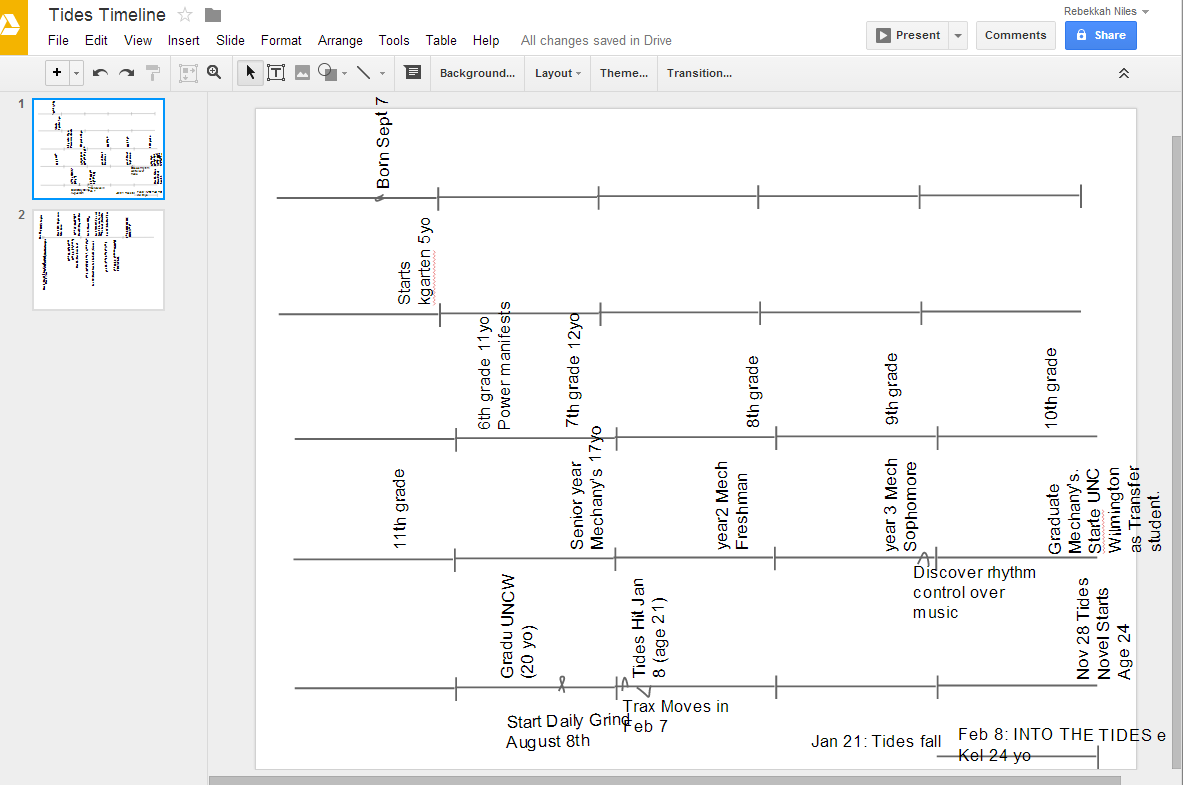
The original calendar sketch was a rough estimate on a Google+ Presentation, something to give me a vague idea of what times I was working with. It actually ended up being fairly close to the final calendar. Here's the beta version:

BETA version. The link has the official calendar!

Why sketch out a timeline of not just the events in the book, but also Kelly's life?

Because it gave me a better idea of who she was, and what she was dealing with as she grew. 

In case you were wondering, Kelly and Trax are Virgos, born September 7. Oh, and they're the rat in the Chinese Zodiac.

Wednesday, June 18, 2014

Trax's Favorite Show

What's Trax's favorite TV show?
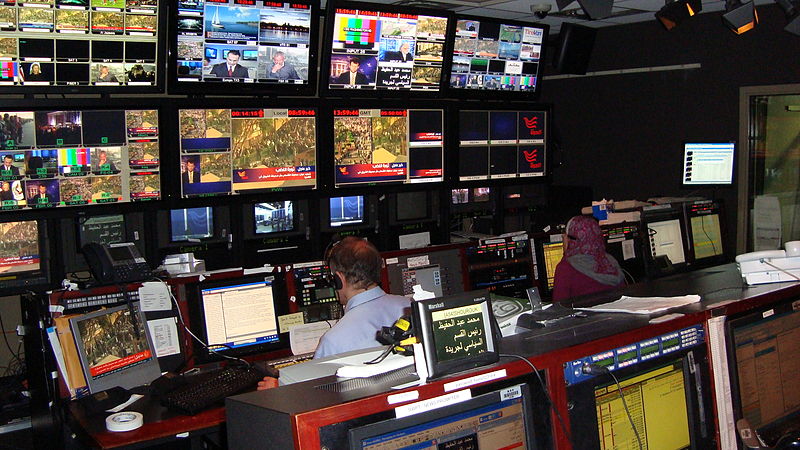
Wholock's Headquarters in Time
(or a Wikimedia commons image)

Super Wholock: the story of the time-traveling ex-detective Wholock and his sidekick Bob, who stop monsters from destroying all of human history throughout all of time and space.

Wholock, a former police detective suffering burnout, retires to a rural Oregon town, where he takes a job as building superintendent for a long-abandoned mansion that has recently been renovated into apartments. There he hears rumors that the former mansion has a spotty history--as in, sometimes it's there; sometimes it's not. Naturally brushing aside this rumor as ridiculous superstition (who ever heard of a disappearing building?) he moves in and meets the first four tenants, including his neighbor, the sarcastic history professor named Bob whose desire to avoid trouble is matched against his tendency to attract trouble, thanks to minor but annoying gift of foresight.

Things quickly to ruin when Wholock discovers a secret room under the basement, where he can see all of time... and the monsters who are coming out of the woodwork to change history so that they, instead of the human race, will rule the world by the modern era. Now Wholock and Bob must use the mansion's magic to save history, while keeping any of the other tenants from discovering the secret of the mansion.

Whether it's discovering the cause behind the Famine of the Fireflies (season 1, episode 19) or nudging a scullery maid and a molding specialist towards new jobs in Area 51 without allowing them to be killed by swamp monsters (season 3, episode 9), Wholock is sure to save the day. 

Wednesday, May 28, 2014

The animals of the Lost

What does the fox say...before it becomes a fox?

In the Broken Powers series, people with Powers who run into concentrated amounts of wild magic are transformed into animal-like creatures that are cold to the touch, called the Lost. Kelly and her friends run into a number of Lost in their journey.

What animal a person becomes is based on their emotional state when they're being changed, and the location in which they changed. The mental state is preserved, and most people they can interact only with other Lost of the same species. Here are just a few of the animal types, and what these Lost were feeling before being transformed:

Butterflies are understandably common--they were panicking. These were mostly people who saw the magic disaster approaching, so those who would have a had a good view south. They had the run-in-circles-screaming kind of reaction to seeing the magic.

On the other hand, raccoons were also afraid, but less so than the panicking crowd. Many of them had enough rationality to try taking shelter in the closest sturdy-looking location, or were afraid for a reason less threatening than the magic.

Foxes are people who were, right before being hit by magic, feeling socially competitive, such as in a team sport. Many either were inside, or so focused on what they were doing they didn't see the explosion of magic that swallowed them. Robins would have been feeling individually competitive, focused on being a single winner in a competition.

Beavers would have purposeful: people engaged in work or study or such, doing a task that required full attention but was not overly exciting. Bees would have been irritable, feeling grumpy and out-of-sorts. Herons, meanwhile, would have been downright angry.

Cats were people who were engaged in artistic or creative pursuits. They were "in the zone," so to speak, and passionately creating something. Rats would have been methodically creative, less artistic fugue and more methodically outlining or plugging away on a necessary but less-loved part of an overall enjoyable project.
Hm, I wonder what that--

Squirrels were feeling cheerful and energetic, most likely spending time with their friends. They were calm, content, and energized, fully engaged with the people around them.

Ants were bored, while deer were confused about what was happening, just slightly afraid but mostly wondering what was going on.

Dogs would have been feeling responsible for others, but calm. Geese would have also been feeling protective about others, but also determined and a bit afraid.

Otters would be those who were confused but curious, investigating something odd.

Mice would have been those who were romantically-minded, while snakes would have been sleepy and comfortable.


Of course, there are many more, and Lost in different locations might become different animals despite feeling the same. 

Wednesday, May 21, 2014

Into the Tides Book Bonus: Mechany's

In Into the Tides, Kelly often refers to her old school, Mechany's School for the Magically Disabled. As a woman with the genes for music magic, being tone-deaf meant she couldn't use her magic as intended. As Kelly puts it:
The school courtyard might look something like this. It's a
very nice place, as the staff and students have to reside
there 24-7 during the school year, and as it does have
private corporate donors who can afford to make it
a desirable place to go.
Dad had tried to tutor me, at first, but not even he could fix the fact that I’d inherited Mom’s complete tone deafness. So while Trax had been taking full advantage of his lack of Powers to do what Dad never could, selling his first record at 17, I had been getting shuttled off to Mechany's, a super-intensive school for “fixing” magical learning disabilities in students of all ages. I wasn't powerful enough to be dangerous, but I was powerful enough that I could have been useful—if I could use my magic.
While Mechany's, located in the South, became trapped in a bubble of magic with the rest of region three years before the start of the novel, Kelly spent much of her young adulthood there. Magic tends to develop with puberty, and so although Kelly describes the school as "all ages," mostly it's grades 6-college, with many of the college courses open to students of all ability levels, including non-magical students. Courses in grades 6-high school include standard maths, literature, history, and science; but there is also a great focus on magic theory, and magic practicums are required for every student. The school day is 8 hours, but this includes activity time, study time, and meal breaks.

While, like with learning disabilities, magic disabilities cannot actually be "cured," students can learn to use their magic fluently. The focus of the school is finding ways to allow students whose magic functions abnormally to achieve normal, near-normal, or alternatively functional* magic usage.
(*Magic abilities are determined by genetics. Each type of magic is called a Power. Frequently variations are minor and specific to the individual. Occasionally, significant variations that are highly unrelated to the parent Power may occur. If the individual exceeds a certain strength of magic [is third class or above], and/or if the capabilities are fully passed on to descendants, the new abilities are considered to be a new type of Power. The regeneration Power, which allows for healing wounds, for example, originally branched off from strength Power, which increases the rate at which muscle develops and causes muscles to heal more quickly.)
Students with unusual impairments may (and usually do) agree to be paired with tutor-researchers, who study magic developmental abnormalities and magic in general. These tutor-researchers give them one-on-one aid, and in return collect data on the abnormality that is shared with the college and eventually with the scientific community as a whole (through papers in peer-reviewed journals). The process by which students' issues are resolved are shared freely among the tutor-researchers and among similar schools across the world, although as much of the student's personal information and the researcher's conclusions and data as possible are kept private.

Students with common magical disabilities for which there are known or effective methods of solving, or students whose magical disabilities seem easily resolved and who are in particularly large classes, may not have their own tutors. They get their aid solely through the magical practicum courses, which often involve up to fifteen students in one-hour courses each day. The teachers are highly experienced, with new teachers serving as apprentices for several years with more experienced teachers. In addition, larger classes usually a teacher aide, and students in the college studying magic often spend semesters helping out in the classroom. Because the school is privately funded, teachers and aides are paid far more than the national average teacher salary.

Students in lower grades are either students who develop magic early, physically develop early, or are the children of school staff. Since the school is a boarding school, sometimes children with normal-functioning magic or no magic at all will accompany their siblings. These classes tend to be very small.

Mechany's College is a private college dedicated the study of cognitive sciences and magic, including the majors magic (general), magic development, magic research methods, magical abnormalities, and other magic-related majors; as well as majors in standard cognitive sciences such as developmental and education psychology. Students without magical abnormalities are encouraged to apply for full tuition (minus whatever student aid they can get, of course). Former Mechany's students who have mastered their abilities and returned to regular high schools (or graduated from Mechany's, in the case of those who mastered their abilities but elected to pay full boarding school tuition instead of transferring) may enter the college for half in-state tuition. Current Mechany's students who have not fully mastered their magic by the completion of high school are encouraged (or in cases of public safety, required) to attend the college free of charge until they and their professors are confident of ability mastery. In some cases, this may include graduate and post-graduate courses.

A very few individuals with particularly unstable abilities have been extended "lifelong fellowships," and are given positions in the schools, where researchers continue to try to help them achieve control while allowing them the dignity of full-time employment and keeping them in a location prepared for and capable of dealing with magical mishaps.

The major types of common magical disabilities, and some strategies for overcoming them:

Mismagica ("Magical dysgraphia"): a student attempts to use one magical ability, but uses a different one instead.
  •  Some treatments: holding a different 3D shape when using each ability, so as to physically give shape to ability. Practicing thinking of each ability as a different color, and "casting colors" instead of using the separate abilities. Using gestures specific to each ability. Say the name of the ability to be used.
Misaccuria ("Magical inaccuracy"): Student attempts to use magic on one subject, but uses it on an unintended subject instead.
  • Some treatments: Implementing a target-identification routine, where student gets in the habit of consciously verifying the target before using magic. Adding visual markers to targets. Encouraging targets to give audible markers. Saying the name of the target. Establishing physical contact with desired subject (for some abilities wherein distance is a factor in determining ability level, this method causes the individual to receive a lower class designation). 
Misquantia ("Magical dyscalculia"): Student attempts to use magic at a certain strength, but actual amount of magic used is different from the amount intended (i.e., planning to light a candle and setting the desk on fire instead, or planning to float a stack of books but only picks up one instead, or fails entirely despite total weight being within technical capabilities)
  • Some treatments: Exceptional levels of practice. Using visual reminders or hand signals (e.g., pinching fingers for smaller amounts of magic and holding them further apart for more magic). Practicing regular meditation. Only using magic while meditating. If linked to emotions, practicing emotional control. Listening to classical music or music with strong, regular beats when using magic. Removing distractions and using magic only in distraction-free environments. 
Mislexia ("Magical dyslexia"): (Specific to physical sense-enhancing abilities) Student senses incorrect data through magic (e.g., travel Power senses a tree a foot further away than it is and runs into it; a telekenetic Power senses a book to the right when it is really to the left; a music Power hears notes in a song in the incorrect order)
  • Some treatments: Avoid relying on single sensory input from magic (open eyes and look around when moving; look at object being moved, or stop using magic for 5 seconds and then re-verify location of objects; record music and listen to three times). Extend senses slower and focus for longer (students may experience sensation of objects "shifting" into actual place under extended focus). Hold breath when using magic. Listen to repetitive beat when extending senses. Tap a beat when using sensing ability.
Physical-based impairments (such as a tone-deaf student with music magic, or a blind student with illusion magic): These students' magic normally takes a slightly different than usual form to compensate for the physical handicap (the physical handicap must be present at onset of abilities for this to occur). The magic differences may or may not be genetic, but 90% do not show up in descendants without the physical handicap, and those abilities that do often fade within 2-4 generations.
While the magic adjusts to the student's physical form, the adjustment is not always perfect. Many students are only be able to make partial use of their abilities, and are designated as a lower class level based on the skills they can use.
Other students are incapable of some standard abilities for their technical class level, but those they can perform are much stronger than usual; the student may therefore be classed higher than their technical level. It is also not uncommon for a student to actually fully develop a higher or lower level of magic than would be expected based on family history (e.g., a telekinetic Power with motor impairment and two parents of fourth class developing into a second class telekinetic Power). However, individuals in the former situation, once their abilities are fully tested, are considered stable and would visit an institution such as Mechany's only for identification of available abilities and strengths of those abilities. Individuals in the latter situation are not considered to have a magical disability, and would not attend Mechany's for specialized instruction or testing at all.
  • Treatment: Helping the student discover the alternative form and realize how to access it, and best use it. This may take a long time of trial and error, or may be intuitive. Treatments and strategies vary per student and usually depend on student's Power type and physical disability.
Powered individuals with certain cognitive-affecting disorders, such as individuals with autism, brain injuries, Down Syndrome, or limited cognitive development, are also served at Mechany's, even if their abilities are normal for the Power type, especially if the traditional school systems' services and the local Power Licensing office's services are insufficient for the student's abilities. Students with special needs are included in normal class settings to the greatest extent possible. If needed, staff may train the entire family in helping the affected family member control and deal with magic. Usually this is sufficient and in most cases, the family returns home to implement these strategies, staying with contact from local Power Licensing offices if they need additional minor assistance.
In some cases, complete control may not be possible, and (as with students with uncontrollable abilities), the family members interested in doing so and (if capable) the individual may be offered full-time employment as possible. However, the government also has several programs to help families in this situation, and many elect to take advantage of those instead, as those are frequently closer to home.


Being tone deaf, Kelly always considered her music magic useless. But when her neighbor Derik invites her on a salvage mission in the magic-devastated American South, she discovers she can hear the voices of the people lost.

Now, hoping to save the family she lost, she'll seek out a way to collapse the bubble of magic drowning most of the region. But Derik and her only surviving relative--her twin brother--aren't about to let her face being trapped forever in the magic herself, or death by its monsters.

Trying to get back everyone she's lost might just cost her everyone she has left.

Available on: